What Is a Ten-Frame? A Parent's 5-Minute Guide
If your child has started primary school recently, you've probably heard the words "ten-frame" at a parent-teacher night and nodded politely. Here's the two-minute version, minus the jargon.
It's a box of ten, and that's the point
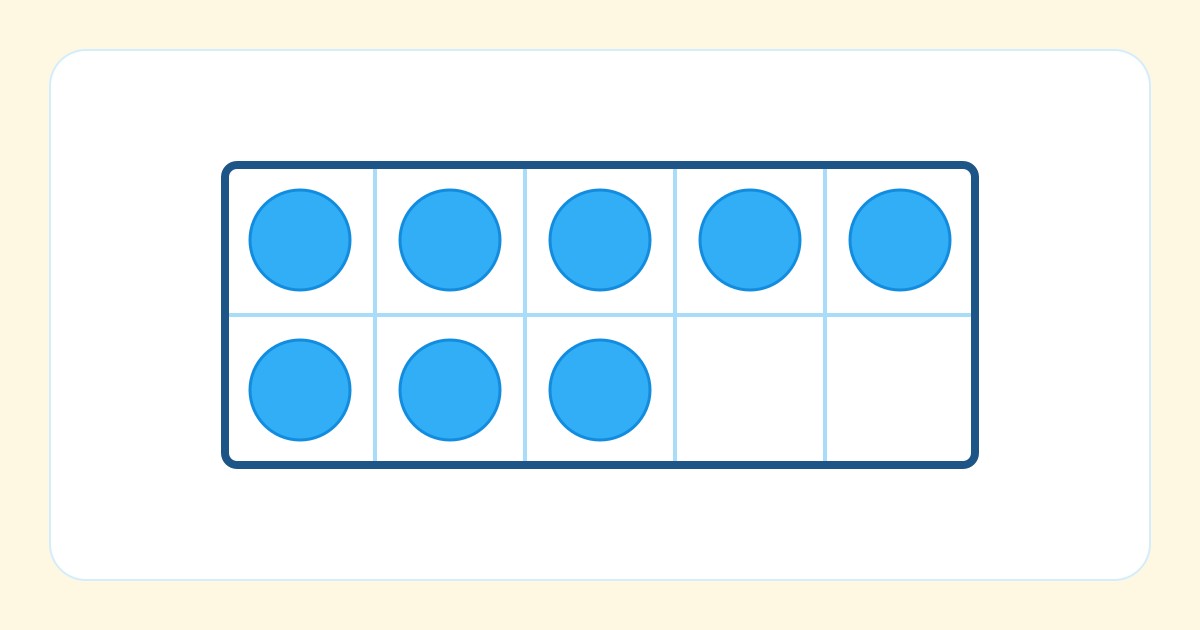
A ten-frame is simply a grid of ten squares - two rows of five. Children place counters in the squares to show a number. Seven looks like a full row of five plus two more; nine looks like a full frame with one gap.
That layout does something quietly powerful: children stop counting one-by-one and start seeing numbers as chunks. Nine stops being "1, 2, 3, 4, 5, 6, 7, 8, 9" and becomes "ten with one missing". That instinct - called subitising - is one of the strongest foundations for mental arithmetic.
Why teachers (and Ziado) use them before equations
Effective maths teaching moves from concrete (things you can touch), to representational (pictures), to abstract (symbols like 8 + 5). The ten-frame is the classic first step on that ladder. When a child later meets "8 + 5", they can picture the eight-frame filling up to ten and spilling three into the next frame - and suddenly "make ten" strategies feel obvious rather than taught.
It's exactly how maths works in Ziado: new ideas start as counters and ten-frames on screen, and only become bare equations once the picture is solid in your child's head.
Two easy ways to use ten-frames at home
- The egg carton trick. Cut an egg carton down to ten cups. Toss in some dried pasta and ask: "How many? How many more to fill it?" That second question is the whole game.
- Snack maths. Arrange crackers in two rows of five. Eat two, dramatically. "How many are left? How did you know so fast?" Naming the strategy out loud is where the learning sticks.
Five minutes here and there is genuinely enough. And if you'd like to know exactly which number skills your child has locked in already, the free check will show you in about ten minutes.