The bar model explained for parents (Australia)
Your Year 3 child is stuck on a homework question: "Lily has 35 marbles. Sam has 18 more than Lily. How many marbles do they have altogether?" They have circled the numbers, added 35 and 18, written 53 and moved on. The answer is wrong, but not because their adding is weak. They answered a different question from the one on the page.
Then you notice the worksheet expects a drawing first: two long rectangles, one under the other, with a short extra piece hanging off the bottom one. That drawing is a bar model (also called a tape or strip diagram). Many Australian schools teach it as a way to picture what a word problem says before any calculating starts.
This guide explains what a bar model is, why teachers like it, the main types your child will draw, worked examples from Year 1 to Year 6, and how to help at home without taking over.
What is a bar model?
A bar model is a simple sketch that uses rectangles to stand for amounts. Longer bars mean bigger amounts. Bars can be split into pieces to show parts, lined up to compare two amounts, or chopped into equal boxes to show groups and fractions.
The bars don't need to be measured or neat; they just need to match the story. Once the drawing is right, the child can usually see whether to add, subtract, multiply or divide.
Think of it as a halfway point between counting real objects and working with bare numbers: rectangles can stand for any size of number, from 7 to 7,000.
Why schools teach bar models
The hardest part of a word problem is rarely the arithmetic; it's working out what is going on. Children who skip that step tend to grab the numbers and use whichever operation they practised last. The guide to word problems looks at this "number grabbing" habit in more detail.
A bar model slows things down in a helpful way. To draw it, your child has to decide:
- What is the whole, and what are the parts?
- Is one amount being compared with another?
- Are there equal groups or equal shares?
- Which piece is unknown?
Those questions are the real thinking. The bar model just gives them somewhere to land on paper.
Bar models also carry across topics. The drawing that helps a Year 1 child with "8 birds, 3 fly away" later helps with fractions, percentages and ratio, so the picture stays familiar while the numbers change.
The three main kinds of bar model
Most bar models in primary school fall into three families. Knowing which one fits a problem is half the battle.
1. Part–whole bars
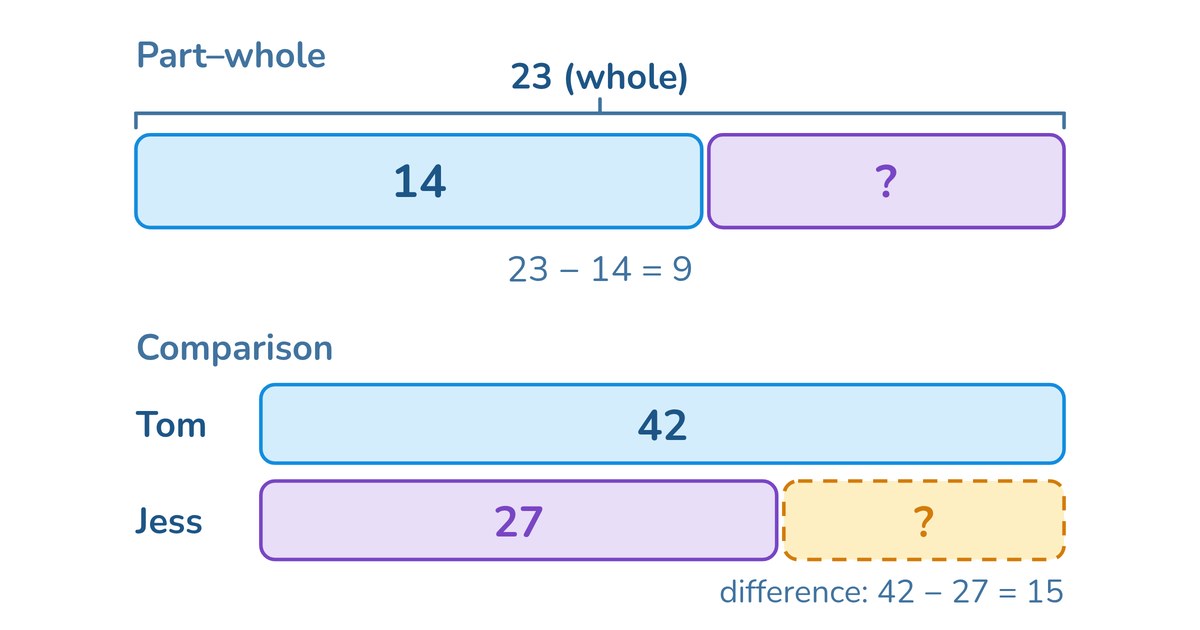
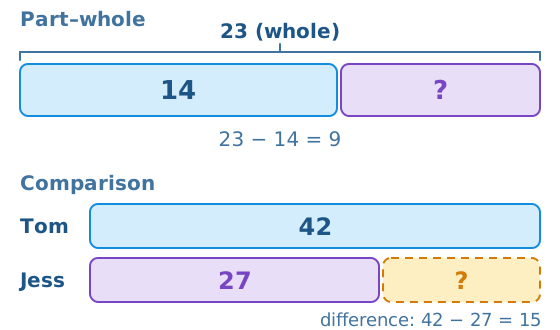
One long bar shows the whole, split into parts. If you know the parts, add them to find the whole. If you know the whole and one part, subtract to find the missing part.
Example: Mia had 14 stickers. Her aunt gave her some more and now she has 23. How many did her aunt give her?
Draw one bar labelled 23. Split it into a piece labelled 14 and a piece with a question mark. The missing piece is 23 − 14 = 9.
This is the same idea as the part-part-whole model children use with counters in the early years, just drawn as rectangles. It links closely to fact families too, because 14 + 9 = 23, 23 − 14 = 9 and 23 − 9 = 14 all describe the same bar.
2. Comparison bars
Two bars sit one above the other, lined up at the left. The difference in length shows how much more or less one amount is than the other.
Example: Tom scored 42 points and Jess scored 27. How many more points did Tom score?
Draw Tom's bar longer than Jess's. The extra bit at the end of Tom's bar is the difference: 42 − 27 = 15.
Words like "more" tempt children to add; a comparison bar shows that "how many more" means finding a gap. For other ways of thinking about bigger and smaller, see comparing numbers.
3. Equal-unit bars
A bar is cut into equal boxes, or units. This family handles multiplication, division, fractions and ratio.
Example: Ben has 3 times as many footy cards as Ava. Ava has 12. How many does Ben have?
Draw Ava's bar as one box labelled 12. Draw Ben's bar as three boxes the same size. Ben has 3 × 12 = 36 cards. Together they have 4 boxes, or 48 cards.
Once children see a bar as a row of equal units, multiplication and division stop feeling like separate tricks and become two ways of reading the same picture.
Back to the marble question
Here's how a bar model would have helped with Lily and Sam.
- Draw Lily's bar and write 35 on it.
- Draw Sam's bar underneath, the same length as Lily's plus an extra piece. Label the extra piece 18.
- Put a bracket around both bars with a question mark: that's what the question wants.
Now the picture shows two steps. Sam has 35 + 18 = 53. Altogether they have 35 + 53 = 88.
The answer of 53 was Sam's total, not the combined total, and the drawing makes that visible.
Bar models from Year 1 to Year 6
The drawing changes a little as children grow, but the habit is the same.
Year 1 and Year 2. Small numbers, one step. Children often start with cubes or a row of counters, then draw a bar around them, then drop the counters and keep the bar. "There were 17 kids on the bus. 9 got off. How many are still on?" The whole is 17, one part is 9, the other part is 17 − 9 = 8.
Year 3 and Year 4. Bigger numbers, comparison problems, and first two-step problems. A food drive collects 240 cans over three days: 70 on Monday, 20 more than that on Tuesday, and the rest on Wednesday. Tuesday is 70 + 20 = 90. Wednesday is 240 − 70 − 90 = 80. The bar shows the whole of 240 split into three pieces, which helps children see that two subtractions are needed.
Year 5 and Year 6. Fractions, percentages, ratio and the classic "units" problems. These are where bar models really earn their keep, and they get their own section below.
Fractions on a bar
A bar cut into equal pieces is a natural way to show a fraction of a set or a quantity.
Find 2/5 of 30. Draw a bar for 30 and cut it into 5 equal boxes. Each box is 30 ÷ 5 = 6. Two boxes are 2 × 6 = 12.
Find 3/4 of 24. Four boxes, each worth 24 ÷ 4 = 6. Three boxes make 18.
The really powerful step comes when the problem runs backwards.
Three-fifths of a class walk to school. That's 18 children. How many children are in the class?
Draw a bar with 5 equal boxes and shade 3 of them. Those 3 boxes are 18, so one box is 18 ÷ 3 = 6. The whole bar is 5 × 6 = 30 children.
A memorised rule doesn't say which way round to go; the picture does. For more on the fraction ideas underneath, see fractions explained.
Percentages on a bar
A bar can stand for 100%. Cutting it into 4 boxes gives 25% each; cutting it into 10 boxes gives 10% each.
A board game normally costs $80 and is marked down by 25%. What is the new price?
Draw a bar for $80 and split it into 4 equal boxes of $20. One box is the discount. The new price is the other three boxes: $60.
Find 20% of 80. Split the bar into 5 boxes (because 20% is one-fifth). Each box is 80 ÷ 5 = 16.
The guide to percentages of amounts goes further with this, including the shortcuts children learn after the picture makes sense.
Ratio and "units" problems
Upper primary problems sometimes give a total and a relationship and ask for the separate amounts. Bar models let children solve these with plain arithmetic.
Ben and Ava have 60 stickers between them. Ben has three times as many as Ava. How many does each have?
Ava's bar is 1 unit. Ben's bar is 3 units. Together that's 4 units = 60, so 1 unit = 15. Ava has 15 and Ben has 45. Check: 15 + 45 = 60, and 45 is three times 15.
Ella and Noah have 50 shells altogether. Ella has 8 more than Noah. How many does Noah have?
Draw two bars, Ella's longer by 8. Take that extra 8 away from the total: 50 − 8 = 42. Now the two bars are the same length, so each is 42 ÷ 2 = 21. Noah has 21; Ella has 21 + 8 = 29.
The ratio of boys to girls in a choir is 2 : 3. There are 25 singers. How many are girls?
Two boxes for boys, three for girls, five boxes in all. One box is 25 ÷ 5 = 5, so there are 3 × 5 = 15 girls and 10 boys. The guide to ratios has more practice ideas.
How bar models connect to the equals sign
A bar model is a picture of balance: the whole bar is the same as its parts put together. Mia's sticker bar could be written as 14 + □ = 23. Children who read = as "is the same as" switch between bars and number sentences more easily; see the guide to the equals sign.
Helping your child draw bar models at home
You don't need to be an expert in bar modelling yourself. A few habits go a long way.
Read the whole problem first. Ask your child to tell you the story in their own words before they touch the pencil. "So there are two kids with marbles, and one has more…"
Ask "what do we know, and what are we finding?" Get them to point to each number in the problem and say what it stands for.
Let the bars be rough. Rulers and neat shading are not the point. A quick sketch on scrap paper is fine.
Label everything. Numbers go on or above the bars; the unknown gets a question mark. An unlabelled bar is just a rectangle.
Calculate after drawing, not before. If they want to jump straight to a sum, say, "Show me on the bars first, then do it."
Check the answer against the picture. Does the answer fit? Is the longer bar the bigger number? Does the part fit inside the whole?
Use real objects for younger children. Line up Lego bricks or pegs, then draw rectangles around them.
If the school uses a different layout, follow the school's lead.
Common mistakes and what to say
Drawing bars the wrong length. A child might draw the smaller amount as the longer bar. Ask, "Who has more? Which bar should be longer?"
Forgetting the question mark. Without marking the unknown, children often find the wrong piece. Ask them to show you with a finger what the question is asking for.
Stopping after step one. In two-step problems, children often find a middle number and stop. Point back to the question mark: "Is that the thing we were asked to find?"
Adding whenever they see "more". "How many more" is a comparison, not a total. Comparison bars help show that it's the gap between two amounts.
Unequal units. When a problem says "three times as many", all three boxes need to be the same size as the first. Uneven boxes lead to muddled reasoning.
Bar models and the Australian Curriculum
Version 9 of the national maths curriculum doesn't require one particular drawing method. It does expect children at every year level to model situations, choose efficient strategies and explain their thinking when solving problems with addition, subtraction, multiplication, division, fractions, percentages and ratio. Bar models are one of the most common tools teachers use to meet those expectations, along with number lines, arrays and part–whole diagrams.
The Victorian Curriculum 2.0 has similar expectations about representing and solving problems, and each school chooses its own approach and order.
Bar model skills by year level
Year 1: acting out part–whole stories with objects, then sketching a bar around them. See Year 1 maths.
Year 2: one-step addition and subtraction stories drawn as part–whole bars; simple sharing. See Year 2 maths.
Year 3: comparison bars ("how many more"); first two-step problems with numbers into the hundreds. See Year 3 maths.
Year 4: equal-unit bars for multiplication and division; fractions of a quantity. See Year 4 maths.
Year 5: multi-step problems, reverse fraction questions, simple percentages of amounts. See Year 5 maths.
Year 6: ratio and units problems, percentage discounts, problems with several unknowns linked together. See Year 6 maths.
Quick games and activities
- Lego stories. Build two towers of different heights. Make up a story ("Dad's tower has 6 more bricks than mine") and draw the bars together.
- Mystery piece. Draw a labelled bar with one piece marked with a question mark. Your child finds the missing number, then draws one for you to solve.
- Swap roles. Your child writes a word problem to match a bar you have drawn. Inventing problems is one of the fastest ways to understand them.
Five minutes is plenty. If your child gets frustrated, step back to smaller numbers or real objects. The guide to homework without tears has ideas for keeping practice calm.
When to look more closely
Many children find word problems hard for a while, especially the first time a problem has two steps or uses comparison language. Worth raising with the teacher: your child in Year 4 or above still can't tell which operation a simple one-step problem needs, can't explain what any number in a problem stands for, or becomes very upset whenever a word problem appears.
Stress around maths is common and can be eased; the guide to maths anxiety in children may help. For the wider picture, read when to worry about maths or is my child behind in maths?. An online article can't judge where a particular child is at, so if worries continue, have a chat with the classroom teacher.
FAQ
What is a bar model in maths?
A bar model is a drawing that uses rectangles to stand for amounts in a problem. Longer bars mean bigger amounts. Splitting or lining up the bars shows whether to add, subtract, multiply or divide.
Why does my child's teacher want a drawing before the answer?
The drawing shows how your child understood the problem. A correct picture with a small calculation slip shows good thinking; a wrong picture explains why the answer went astray.
What year do kids learn bar models?
It varies by school. Many children start with simple part–whole bars in Year 1 or Year 2 and use them for fractions, percentages and ratio by Years 5 and 6.
Try this tonight
Take one word problem from your child's homework or make one up. Before any numbers are worked out, ask your child to draw the bars and tell you what each one stands for. Then let them do the calculation and check that the answer fits the picture.
Curious about how your child is travelling across maths more widely? The Ziado free check is an adaptive set of questions taking about ten minutes at home, and it gets easier or harder depending on your child's answers. You'll see some results instantly (no login, no card), and the full placement unlocks after sign-up. Bar modelling isn't scored on its own, the check isn't aimed at NAPLAN, and it doesn't diagnose any learning difficulty. To get a sense of regular practice, have a look at Ziado maths. Both plans, Individual or Family, come with 14 days free to start; current options are on the pricing page.
Want to see where your child's maths skills sit?
Ziado's free check is a one-off, roughly 10-minute adaptive diagnostic with partial results only - no account, no card. The full placement unlocks after signup.
Start the free maths check