Divisibility rules explained for parents (Australia)
A Year 5 worksheet asks, "Is 3,456 divisible by 9?" No calculator allowed. Your child is stuck, and you half remember something about adding the digits but not why, or whether it works for 4 or 6.
Divisibility rules are quick checks that tell you whether one whole number shares evenly into another, with nothing left over, without doing the full division. Once a child knows them, simplifying fractions, finding factors, testing for primes and checking answers all get faster.
Below: what "divisible" means, the rule for each common number from 2 to 12, why the rules work, where kids use them, typical mistakes, the curriculum, and a few home games.
What does "divisible" mean?
A number is divisible by another number if dividing gives a whole-number answer with no remainder.
- 24 is divisible by 6, because 24 ÷ 6 = 4 exactly.
- 25 is not divisible by 6, because 25 ÷ 6 = 4 remainder 1.
"24 is divisible by 6", "6 is a factor of 24" and "24 is a multiple of 6" all describe one relationship, and teachers switch between them. If the words factor and multiple still feel slippery, the factors and multiples guide covers them gently.
A divisibility rule answers a yes-or-no question: whether the division works out evenly, not what the answer is.
The last-digit rules: 2, 5 and 10
These are the easiest, and many children pick them up in Years 3 and 4.
Divisible by 2
A whole number is divisible by 2 if its last digit is 0, 2, 4, 6 or 8. In other words, if it is even.
- 3,758 ends in 8, so it is divisible by 2.
- 941 ends in 1, so it is not.
The odd and even guide has more on why only the ones digit matters here.
Divisible by 5
A whole number is divisible by 5 if it ends in 0 or 5.
- 1,235 ends in 5: yes.
- 652 ends in 2: no.
Divisible by 10
A whole number is divisible by 10 if it ends in 0.
- 4,370: yes.
- 4,375: no (though it does pass the test for 5).
Why only the last digit matters
This sets up every other rule. Think of 3,758 as 3,750 + 8. The 3,750 part is made of tens, and every ten splits evenly into twos, fives and tens. So the only part that can cause trouble is the ones digit on the end. If the ones digit shares evenly, the whole number does. A quick look at place value helps this click.
The last-two and last-three digit rules: 4, 8 and 25
Divisible by 4
Look at the last two digits only. If that two-digit number is divisible by 4, so is the whole number.
- 516: the last two digits are 16, and 16 ÷ 4 = 4. So 516 is divisible by 4 (516 ÷ 4 = 129).
- 738: the last two digits are 38, and 38 ÷ 4 = 9 remainder 2. So 738 is not divisible by 4, even though it is even.
Why it works: every hundred is exactly 25 fours. So in 516, the 500 part always shares evenly into fours, and only the 16 is left to check.
A handy fallback if your child doesn't know their four times table well: halve the number, then halve again. If both halves come out whole, the number is divisible by 4. For 516, half is 258, and half again is 129. Both whole, so yes. The doubling and halving guide can help here.
Divisible by 8
Look at the last three digits. If that three-digit number is divisible by 8, the whole number is too.
- 7,456: the last three digits are 456, and 456 ÷ 8 = 57. So 7,456 is divisible by 8.
- 2,180: the last three digits are 180, and 180 ÷ 8 = 22 remainder 4. So no.
Why it works: 1,000 is exactly 125 eights, so the thousands never matter. Halving three times is the friendly backup: 456 → 228 → 114 → 57, all whole, so yes.
Divisible by 25
The last two digits must be 00, 25, 50 or 75. So 1,375 passes (1,375 ÷ 25 = 55).
The digit-sum rules: 3 and 9
Divisible by 3
Add up the digits. If the total is divisible by 3, the original number is too.
- 372: 3 + 7 + 2 = 12, and 12 is in the three times table. So 372 is divisible by 3 (372 ÷ 3 = 124).
- 247: 2 + 4 + 7 = 13, and 13 is not a multiple of 3. So 247 is not divisible by 3.
Divisible by 9
Same idea, but the digit total has to be divisible by 9.
- 3,456: 3 + 4 + 5 + 6 = 18, and 18 is a multiple of 9. So 3,456 is divisible by 9 (3,456 ÷ 9 = 384).
- 1,234: 1 + 2 + 3 + 4 = 10, not a multiple of 9. So no.
If the digit total is still big, just add its digits again. For 99,999 the digits add to 45, and 4 + 5 = 9, so it is divisible by 9.
Why adding the digits works
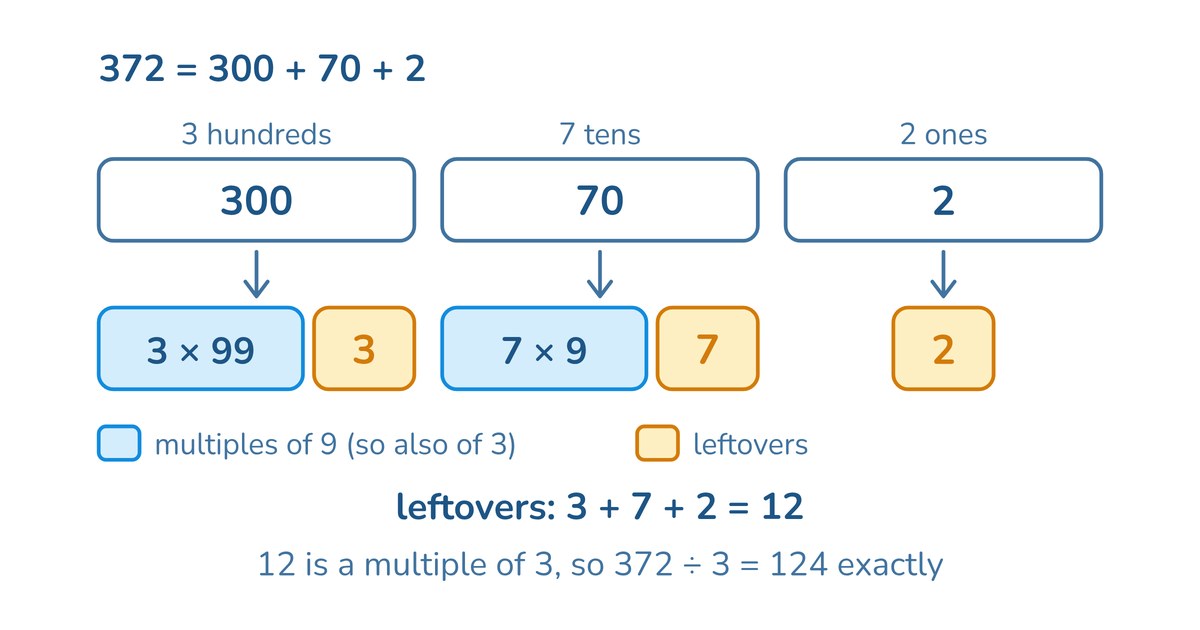
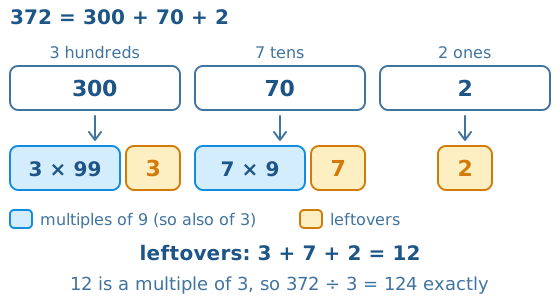
A kitchen-table version: every 10 is one more than 9. Every 100 is one more than 99. Every 1,000 is one more than 999. And 9, 99 and 999 are all in the nine times table (and the three times table).
Split 372 into 3 hundreds, 7 tens and 2 ones. Pull a 99 out of each hundred and a 9 out of each ten, and the leftovers are 3 + 7 + 2 = 12. Everything pulled out is a multiple of 9, so only the digit sum needs checking.
There's a bonus here too. The digit sum also tells you the remainder when you divide by 9. For 247, the digit sum is 13, and 1 + 3 = 4. Sure enough, 247 = 9 × 27 + 4, so the remainder is 4. The remainders guide has more about what to do with leftovers.
The combining rules: 6 and 12
Divisible by 6
A number is divisible by 6 if it passes both the test for 2 and the test for 3.
- 144: it's even, and 1 + 4 + 4 = 9 is a multiple of 3. So 144 is divisible by 6 (144 ÷ 6 = 24).
- 134: it's even, but 1 + 3 + 4 = 8 is not a multiple of 3. So no.
Divisible by 12
A number is divisible by 12 if it passes the test for 3 and the test for 4.
- 3,456: the digits add to 18 (passes 3), and 56 is a multiple of 4 (passes 4). So 3,456 is divisible by 12 (3,456 ÷ 12 = 288).
The trap: why not 2 and 6 for 12?
Kids often reason, "12 is 2 × 6, so check 2 and 6." Try 18: it passes both, yet 18 ÷ 12 is 1 remainder 6.
The 2 is already hiding inside the 6. Two tests only combine safely when the numbers share no factor except 1, which is why 6 uses 2 and 3, and 12 uses 3 and 4.
Optional extras: 7 and 11
These turn up in extension work and puzzle books, so skip them if your child already has enough to juggle.
- 11: working from the left, subtract and add the digits in turn. For 1,342: 1 − 3 + 4 − 2 = 0, so it is divisible by 11 (1,342 ÷ 11 = 122). A result of 0 or a multiple of 11 means yes.
- 7: remove the last digit, double it, and take it away from what's left. For 343: 34 − 6 = 28, which is 4 × 7, so 343 is divisible by 7 (343 ÷ 7 = 49). For most primary numbers, plain division by 7 is quicker.
All the rules on one page
| Divisible by | Quick check |
|---|---|
| 2 | Last digit is 0, 2, 4, 6 or 8 |
| 3 | Digits add up to a multiple of 3 |
| 4 | Last two digits make a multiple of 4 (or halve twice) |
| 5 | Last digit is 0 or 5 |
| 6 | Passes the tests for 2 and 3 |
| 8 | Last three digits make a multiple of 8 (or halve three times) |
| 9 | Digits add up to a multiple of 9 |
| 10 | Last digit is 0 |
| 11 | Alternating sum of digits is 0 or a multiple of 11 |
| 12 | Passes the tests for 3 and 4 |
| 25 | Last two digits are 00, 25, 50 or 75 |
Where children actually use divisibility rules
Simplifying fractions
To simplify, divide top and bottom by a number that goes into both. The rules find that number fast.
- 42/56: both even, so halve them to get 21/28. Then 21 and 28 are both in the seven times table, which gives 3/4.
- 135/180: both end in 5 or 0, so divide by 5 to get 27/36. Both digit sums are 9, so divide by 9 to get 3/4.
The simplifying fractions guide goes through this step by step.
Finding factors
Listing the factors of 72 goes faster with the rules: it's even (2), its digits add to 9 (3 and 9), and 72 is a multiple of 4. And 5 and 10 are out at a glance.
Testing for prime numbers
A prime number has exactly two factors: 1 and itself. To test a number like 91, a child can check 2 (odd, no), 3 (9 + 1 = 10, no), 5 (doesn't end in 0 or 5, no), then 7. And 91 = 7 × 13, so it isn't prime, even though lots of kids (and adults) guess that it is.
For 97 you only need to try 2, 3, 5 and 7, because 10 × 10 is already past 97. None go in, so 97 is prime. In general, you only need to test divisors up to the number's square root, because any bigger factor pairs with a smaller one you've already checked. For more on what makes a number prime, see the prime numbers guide.
Sharing and grouping problems
"Can 87 kids form 3 equal teams?" Digits add to 15, so yes, 29 each. The rule settles yes or no; division or long division finds the number.
Leap years
A year is a leap year if it's divisible by 4, but century years must be divisible by 400 (so 1900 wasn't one and 2000 was). So 2028 is a leap year (28 is a multiple of 4), but 2026 isn't (26 isn't). The calendar guide has more date maths.
Common mistakes and how to help
Using a last-digit test for 3. Children often think 13, 23 and 43 are divisible by 3 because they end in 3, or that 27 isn't because it ends in 7. Remind them that the last-digit trick only works for 2, 5 and 10. For 3, they need to add every digit.
Thinking every even number is divisible by 4. 14, 38 and 738 are even but don't share into fours. Check the last two digits or halve twice.
Forgetting about zero. A number that ends in 0 passes the tests for 2, 5 and 10 all at once, and 0 itself is divisible by any whole number other than 0, because 0 ÷ 5 = 0 with nothing left over.
Mixing up "divisible by" and "divided by". The first is a yes-or-no question; the second wants an answer. Rephrase as "Would 4 go into this exactly?"
Relying on rules before knowing the times tables. The rules work best once a child knows multiples of 3, 4, 8 and 9. Shaky times tables? Skip counting is a gentle way in.
What the Australian Curriculum expects
Under version 9 of the Australian Curriculum: Mathematics, divisibility appears directly in Year 5. Children are expected to express natural numbers as products of their factors, recognise multiples and determine whether one number is divisible by another.
It builds on Year 4 work explaining and using the properties of odd and even numbers. In Year 6, they move on to prime, composite and square numbers, describing how each kind behaves and using that to solve problems and make calculations simpler. Divisibility rules are one of the most useful tools for both.
The curriculum doesn't name the individual shortcuts, so schools choose which rules to teach and when. Ask your child which ones their class has covered. To see how this sits within the wider year, read what Year 5 covers and what Year 6 covers; the groundwork is in Year 4 maths.
Easy ways to practise at home
Number plate detective. Test the digits on number plates or letterboxes: divisible by 3? By 9? By 4?
Birth year puzzles. Was the year your child was born a leap year? What about Grandma's?
Rule of the week. One rule per week on the fridge; test page numbers, footy scores and prices.
Beat the calculator. Call out a four-digit number. Your child uses the rules to decide if 6 goes in; you use a calculator. Kids often win, which does wonders for confidence.
Make a number. Ask for a four-digit number divisible by 9, or by 4 but not 8.
Keep it short and playful. The maths anxiety guide has more ideas if that's your situation.
When to look a bit closer
Needing reminders about the rules is normal. It's worth a closer look if an upper primary child can't recall basic multiplication facts, can't see that 24 shares into groups of 6, or gets very upset by any division. Earlier building blocks may need attention. The guides on when to worry about maths and is my child behind in maths? can help you think it through. The teacher is a good next step, and if homework keeps ending in tears, homework without tears has some practical ideas.
FAQ
What are divisibility rules?
Quick checks that show whether one whole number divides into another with no remainder, without doing the division. For example, a number is divisible by 3 if its digits add up to a multiple of 3.
What is the divisibility rule for 4?
Look at the last two digits. If they make a number that's divisible by 4, the whole number is too. You can also halve the number twice: if both halves are whole numbers, it's divisible by 4.
What year do Australian kids learn divisibility rules?
Under the Australian Curriculum (version 9), determining whether one number is divisible by another is part of Year 5. Many children meet the rules for 2, 5 and 10 earlier, and use the rules again in Year 6 when working with prime and composite numbers.
Try this tonight
Write 3,456 on a scrap of paper and challenge your child to find every number from 2 to 12 that divides into it evenly, using only the rules. (Spoiler: it's divisible by 2, 3, 4, 6, 8, 9 and 12, but not 5, 7, 10 or 11.) Then ask them to explain how they knew.
Curious how your child is tracking in maths more broadly? The Ziado free check takes about ten minutes at home, and the questions shift up or down depending on how your child responds. You'll see an initial snapshot straight away with no sign-up or payment details; a fuller placement follows once you create an account. It won't give a separate score for divisibility, it's not designed as NAPLAN preparation, and it isn't a diagnostic test for a learning difficulty. To see what regular practice involves, have a look at Ziado maths. Both the Individual and Family plans start with 14 free days, and pricing lists the current options.
Want to see where your child's maths skills sit?
Ziado's free check is a one-off, roughly 10-minute adaptive diagnostic with partial results only - no account, no card. The full placement unlocks after signup.
Start the free maths check