Improper fractions explained for parents (Australia)
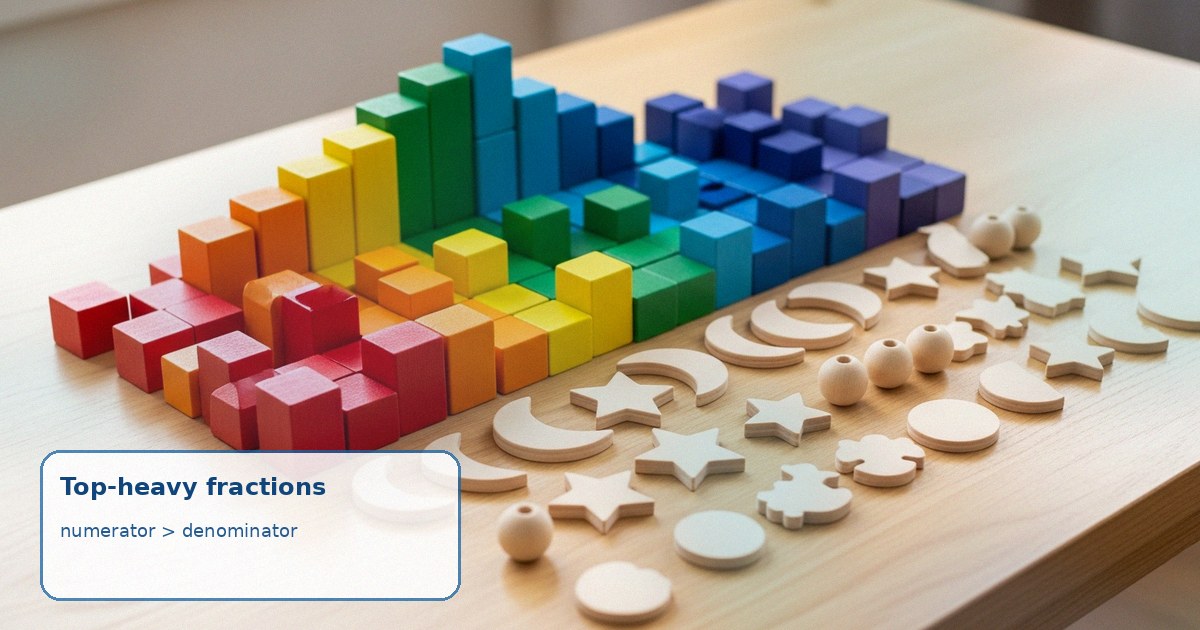
Homework shows 5/2 or 11/4, and Australian parents wonder why the top number is bigger than the bottom - or why the teacher said "top-heavy". In primary classrooms, an improper fraction (sometimes called a top-heavy fraction) has a numerator that is greater than or equal to the denominator. The pieces still make sense: 5/2 means five equal halves - enough to build two wholes and one half more. Counting those pieces, then asking "how many wholes are hiding in this?", comes before any conversion formula.
This guide owns improper / top-heavy meaning: numerator ≥ denominator, concrete equal pieces that make one or more wholes, oral hiding-wholes talk, a clear contrast with proper fractions, and a light convert to mixed. The full mixed ↔ improper teach-through both ways lives on mixed numbers explained - link there; do not treat this page as that deep dive. The equal-parts umbrella sits under fractions explained. Collections live on fraction of a set. Locating unit fractions between 0 and 1 stays on fractions on a number line. Tenths and hundredths as place value belong with decimals; "out of 100" language with percentages. Year maps: Year 4–Year 6 maths.
What an improper fraction means
Improper fraction = numerator ≥ denominator. The top is as big as, or bigger than, the bottom - so the value is one or more.
Example: 5/2.
- Think "five halves"
- Five half-pizzas make two wholes and one half
- Spoken: "five over two" or "five halves"
- Same amount as the mixed number 2 ½ (detail on mixed numbers)
Teachers may say improper fraction, top-heavy fraction, or simply "five halves". Echo the class phrase. The meaning is always "enough equal pieces to make at least one whole" - not "a broken or wrong fraction".
When numerator equals denominator: 4/4 = 1, 8/8 = 1. That is still improper (top matches bottom) and names exactly one whole - a useful bridge, not a trick.
Proper vs improper (the calm contrast)
Proper fractions stay below one: the numerator is smaller than the denominator (½, ¾, 2/5).
Improper fractions sit at or above one: the numerator is ≥ the denominator (3/3, 5/2, 11/4).
Both still use equal parts. Improper is not a different kind of fraction maths - it is the same equal-parts idea when you have enough pieces to reach or pass one whole. If equal parts still wobble, rebuild on fractions explained before more top-heavy worksheets.
Mixed numbers are the friendly "wholes plus a bit" way to say many improper amounts. This page names improper first and converts lightly; mixed numbers explained owns the full pairing and both conversion directions.
Not the same as the whole of fractions
Improper fractions sit inside fraction learning. They are not a separate topic from equal parts - but this page zooms only on top-heavy meaning, hiding-wholes talk, and a light improper → mixed switch.
- Fractions explained - equal parts, unit fractions, comparing and naming
- Mixed numbers explained - whole + proper; full mixed ↔ improper conversion (link; do not duplicate here)
- Fraction of a set - part of a collection (½ of 12 apples)
- Fractions on a number line - locating halves and quarters between 0 and 1 (and lightly beyond 1 later)
- Comparing fractions / equivalent fractions - related fraction cousins; link lightly
- Decimals / percentages - later bridges; link lightly, do not duplicate
At home, separate the jobs: (1) count or build the equal pieces; (2) ask how many wholes are hiding; (3) only then rewrite lightly as a mixed number if homework asks. If the sheet wants mixed → improper both ways in depth, open mixed numbers.
Concrete first: pieces that make wholes
Abstract "5/2 is improper" lands better after a picture children can see:
Half-pizzas or pancakes. Cut (or fold) several discs into halves. Count five half-pieces. Group them: two pairs make two wholes; one half left. Say: "five halves - two wholes hiding, plus one half." Write 5/2.
Chocolate bars in quarters. Eleven quarter-squares. Ask: "How many groups of four fit into eleven?" → two wholes (eight quarters) and three quarters left → 11/4.
Paper strips. Fold strips into thirds. Collect seven third-pieces → two wholes hiding and one third → 7/3.
Light number-line tip. Mark 0, 1, 2; hop in halves five times from 0. Deeper 0–1 locating stays on fractions on a number line; here the line only shows enough pieces to pass one.
Keep pieces on the table while you write. Symbols label a pile the child already understands - not replace it.
Oral habit: "How many wholes are hiding in this?"
Before any formal conversion, make this question automatic:
- Look at the improper fraction (or the pile of pieces)
- Ask: "How many wholes are hiding in this?"
- Answer by grouping: denominator pieces = one whole
- Name leftovers as the proper part
Example: 11/4
- Denominator 4 → four quarters make one whole
- How many groups of 4 fit into 11? → 2 wholes (2 × 4 = 8)
- Leftover: 11 − 8 = 3 → three quarters
- Spoken: "two wholes hiding, and three quarters"
- Light mixed write: 2 ¾ (full conversion habits on mixed numbers)
Same leftover idea as remainders; grouping language from equal groups / division - fraction clothing, not a new topic.
Light improper → mixed (when homework asks)
Australian worksheets often ask: rewrite 11/4 as a mixed number. Keep it light here; send both-ways depth to mixed numbers.
Calm steps with pieces still in view:
- Ask how many wholes are hiding (groups of the denominator)
- Quotient → whole number
- Leftover → new numerator; keep the denominator
- Write the mixed form (e.g. 2 ¾)
Spoken: "divide numerator by denominator; wholes first; leftover on top; same bottom."
Check by counting pieces again - or, when ready, convert back lightly. If the child races to a formula and loses meaning, pause and rebuild with quarters or halves before more sheet rows.
Do not drill mixed → improper on this page. That direction and the full pairing belong on mixed numbers explained.
Year by year: where improper fractions show up
Year 3 (light) - equal parts; occasional "more than one" language (Year 3 maths; AC Year 3).
Year 4 - clearer improper / top-heavy talk beside comparing and extending past one (Year 4 maths; AC Year 4).
Year 5 - improper → mixed in context; division leftovers as fractions (Year 5 maths; AC Year 5).
Year 6 - fluent top-heavy recognition; light bridges to decimals and percentages (Year 6 maths; AC Year 6). Deep decimals / percentages stay elsewhere. Algebra waits.
At home: pieces first, hiding-wholes second, light mixed rewrite third if asked. Australian Curriculum Mathematics (v9) builds this across middle–upper primary (Year 4–Year 6).
Home games that do not feel like worksheets
Piece pile. Cut ten to twelve paper halves or quarters. Child counts the pieces, writes the improper fraction, then says how many wholes are hiding.
Sticky-note label. Note A: 5/2. Note B: "two wholes and a half". Match pile → improper → spoken wholes. Full mixed teach-through: mixed numbers.
Proper or improper? Cards (2/5, 5/2, 3/3, ¾, 7/4) - sort proper / improper. Celebrate the sort, not speed.
Keep games under ten minutes. If evenings fray - homework without tears.
A simple weekly home routine
- Two minutes of pieces - paper halves/quarters or scored chocolate; build one improper amount and say "___ over ___".
- Five minutes of hiding wholes - one careful "how many wholes are hiding?"; leftover named aloud; write improper form.
- Three minutes of a light check - if homework wants mixed, rewrite once with objects still visible; otherwise stop at the oral wholes answer. For both-ways conversion drills, open mixed numbers.
Stop while friendly. Frequency beats duration. For equal-parts foundations, use fractions explained; for "past 1" on a line, use fractions on a number line.
Common mix-ups (and kinder fixes)
Thinking "improper" means wrong. Fix: say "top-heavy" or "enough pieces for one or more wholes" - the name is classroom jargon, not a mistake stamp.
"Correcting" 5/2 to 2/5. Habit from proper fractions (smaller on top). Fix: count five half-pieces; improper means the top can be bigger.
Skipping the oral wholes step. Child copies a mixed answer without grouping. Fix: "how many wholes are hiding?" with pieces before the pencil.
Treating this page as the full mixed conversion course. Mixed → improper and both-ways fluency: mixed numbers explained.
Jumping to decimals too early. 5/2 becomes 2.5 before halves are solid. Light decimals link later; master top-heavy meaning in fraction clothing first.
Turning the night into comparing or equivalent drills. Those cousins have their own guides: comparing fractions, equivalent fractions.
Tears over a long improper sheet. Shrink the sheet; one carefully counted pile beats five rushed rows - homework without tears, maths anxiety.
Wider foundation worry: Is my child behind in maths?; calm signals: when to worry about maths.
How this links to other guides
- Fractions explained for parents - equal-parts umbrella (not the improper deep dive)
- Mixed numbers explained for parents - whole + proper; full mixed ↔ improper conversion (live; not duplicated here)
- Fraction of a set explained for parents - part of a collection
- Fractions on a number line explained for parents - locating on a line; light beyond-1 tip
- Comparing fractions / equivalent fractions - related cousins
- Decimals explained for parents - tenths/hundredths place value
- Percentages explained for parents - out of 100 language
- Multiplication / division / equal groups - light grouping language
- Remainders explained for parents - leftover idea in fraction clothing
- Year 4–Year 6 maths (Year 5)
- Maths Help hub - more parent guides
Ask the teacher: "When homework shows a top-heavy or improper fraction, do you want the improper form left as is, a mixed number, or either - and which written style should we match at home?"
FAQ
What is an improper fraction?
A fraction where the numerator is greater than or equal to the denominator - for example 5/2 or 4/4. Often called top-heavy in Australian classrooms.
Why is the top number allowed to be bigger?
Because you can have more equal pieces than one whole needs. Five halves is still five equal half-pieces - enough for two wholes and one half.
How is improper different from a mixed number?
Improper is all one fraction (5/2). A mixed number writes wholes plus a proper part (2 ½). Same amount often; different forms. Full conversion both ways: mixed numbers explained.
What should we ask first at home?
"How many wholes are hiding in this?" - group by the denominator, name leftovers, then write if homework asks.
When do Australian children meet improper fractions?
Often Year 4–Year 6 with Year 3 light language. Check your child's year guide and ask the teacher what form homework expects.
A calm next step
When counting equal pieces that make one or more wholes, saying "how many wholes are hiding?", and lightly rewriting as a mixed form when asked feels settled - and you want a wider number-skill snapshot at home - Ziado's free check is a one-off, roughly 10-minute adaptive diagnostic with partial results only - no account and no card. The full placement unlocks after signup. It is not NAPLAN practice and it is not the full product; Ziado's ongoing path is adaptive maths (Foundation–Year 6) plus phonics reading (Foundation–Year 4). Explore Ziado maths if you want practice that can meet fractions, improper amounts and related ideas at the right step. Individual and Family plans, if you continue later, start with a 14-day free trial of the full app — see pricing for current plans.
Improper fractions are top-heavy; percent-of work sits in percentages of amounts for parents.
Improper fractions are top-heavy; reducing sits in simplifying fractions for parents.
Curious where improper fractions sit for your child?
Ziado's free check is a one-off, roughly 10-minute adaptive diagnostic with partial results only - no account, no card. The full placement unlocks after signup.
Start the free maths check