Multiplying and dividing decimals explained for parents (Australia)
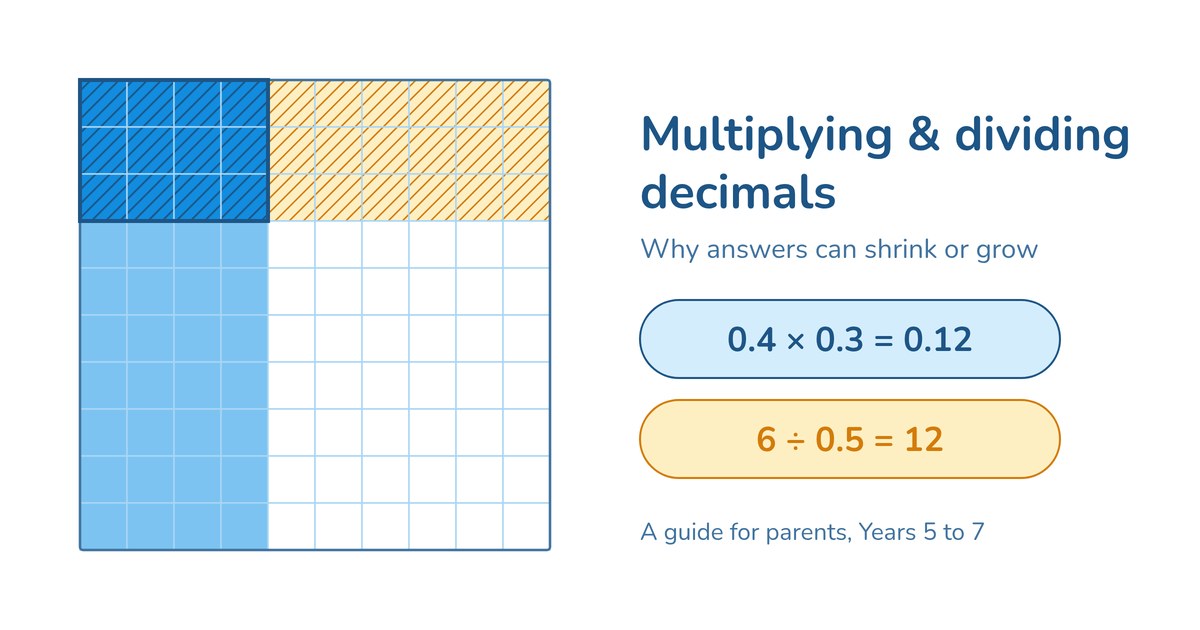
Your Year 6 child works out 0.4 × 0.3 and writes 1.2. The answer sheet says 0.12. They're annoyed, you're puzzled, and neither of you can quite say why the smaller-looking answer is the right one. Then the next question asks for 6 ÷ 0.5, and the answer key says 12, which feels backwards: how can dividing give you more than you started with?
This is where tidy whole-number beliefs get turned upside down. "Multiplying makes things bigger" holds for whole numbers but stops working once a number less than one joins in. The good news is that the methods rest on things your child already knows: times tables, place value and estimating first.
Below: why the answers behave as they do, the methods taught at school with worked examples, quick checks, the curriculum outline, common errors, and ways to practise at home.
Before you start: what your child needs to be comfortable with
Three earlier skills carry this topic. If one is wobbly, that's usually the real reason the decimal work feels hard.
- Knowing what the digits after the point mean. The first place after the point is tenths, the second is hundredths, the third is thousandths. The decimals guide and the place value guide both start from here.
- Reliable times tables. Almost every decimal calculation hides a whole-number fact inside it. 0.6 × 0.7 is really 6 × 7 wearing a disguise. See the times tables guide.
- Powers of ten. Shifting digits by a factor of ten is the engine room of the topic; see why the digits shift with powers of ten.
Children usually meet adding and subtracting decimals first. Its "line up the points" rule does not carry over to multiplication.
The surprise: multiplying can make things smaller
Six lots of a half is 3, so 6 × 0.5 = 3: smaller than 6, because you take only part of each lot. A sequence shows the pattern:
- 6 × 2 = 12
- 6 × 1 = 6
- 6 × 0.5 = 3
- 6 × 0.1 = 0.6
Multiplying by more than 1 makes the answer larger, by exactly 1 leaves it alone, and by something between 0 and 1 shrinks it. That unlocks the 0.4 × 0.3 puzzle: both numbers are under 1, so the answer must be smaller than either. 1.2 is bigger than both, so it can't be right.
Division flips the pattern. 6 ÷ 2 asks "how many 2s fit into 6?" and the answer is 3. But 6 ÷ 0.5 asks "how many halves fit into 6?" Each whole holds two halves, so six wholes hold twelve. Dividing by a number less than 1 gives a larger answer. The division guide explains this "how many groups?" meaning, which is the one that makes decimal division click.
Multiplying a decimal by a whole number
Think of it as repeated addition. 0.3 × 4 means four lots of 0.3: 0.3 + 0.3 + 0.3 + 0.3 = 1.2. Or: 3 tenths × 4 = 12 tenths, which is 1.2.
Use the times-table fact and adjust. For 2.45 × 3, children can multiply 245 × 3 = 735, then remember that 2.45 has two digits after the point, so the answer is 7.35. A quick estimate confirms it: 2.45 is a bit less than 2.5, and 2.5 × 3 = 7.5, so 7.35 is sensible.
Money makes it real. Four pies at $3.65 cost 3.65 × 4 = $14.60. Guess first: about $4 each, so roughly $16. An answer of $146.00 or $1.46 is clearly off. The money maths guide has more shopping problems like this.
Multiplying by multiples of ten, a hundred or a thousand
The Year 6 curriculum asks children to multiply and divide decimals by multiples of powers of ten (numbers like 30, 200 or 4000) without a calculator. The trick is to split the multiplier into two easier steps.
- 0.7 × 30: first 0.7 × 3 = 2.1, then 2.1 × 10 = 21
- 1.25 × 200: first 1.25 × 2 = 2.5, then 2.5 × 100 = 250
- 2.4 × 1000: each digit becomes a thousand times bigger, so the 2 ones become 2 thousands and the 4 tenths become 4 hundreds, giving 2400
Teachers describe this as digits moving into bigger place-value columns, not the point "jumping". Children taught to "add a zero" often write 2.4 × 10 as 2.40, and place value shows why that fails.
Multiplying two decimals
Why 0.4 × 0.3 = 0.12
Draw a 10 × 10 grid, so each small square is one hundredth. Shade 4 columns for 0.4, then cross-hatch 3 rows for 0.3. The overlap is 12 small squares: 12 hundredths, or 0.12.
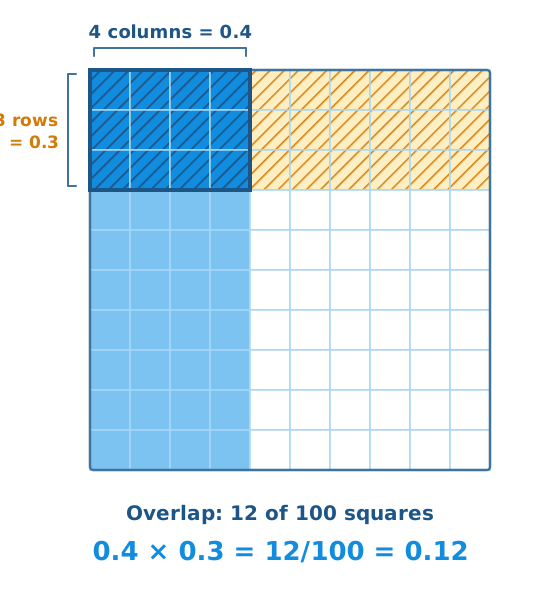
The same idea written with fractions: 4/10 × 3/10 = 12/100. Tenths multiplied by tenths give hundredths, just as a tenth of a tenth is a hundredth. Children who know multiplying fractions often like this version best.
The counting-decimal-places method
Once the idea makes sense, most children use this routine:
- Ignore the decimal points and multiply the whole numbers.
- Count the total number of digits after the point in both numbers.
- Put that many digits after the point in the answer.
Some worked examples:
- 0.4 × 0.3: 4 × 3 = 12; one decimal place plus one decimal place makes two, so 0.12
- 0.2 × 0.3: 2 × 3 = 6; two decimal places needed, so a placeholder zero goes in: 0.06
- 2.5 × 1.2: 25 × 12 = 300; two decimal places, so 3.00, which is just 3
- 1.6 × 0.25: 16 × 25 = 400; three decimal places, so 0.400, which is 0.4
Many children write 0.2 × 0.3 as 0.6. Shading 2 columns and 3 rows of the hundred square shows only 6 tiny squares: 6 hundredths. The zero holds the place guide covers the same idea with whole numbers.
Longer calculations
For bigger decimals, children use the same written method as long multiplication and place the point at the end.
- 3.47 × 6: 347 × 6 = 2082, two decimal places, so 20.82
- 4.6 × 2.3: 46 × 23 = 1058, two decimal places, so 10.58
Estimate first: 4.6 × 2.3 is roughly 5 × 2 = 10, so an answer near 10 is right and 105.8 or 1.058 are not. The estimate before you add habit works just as well here.
Dividing a decimal by a whole number
Here the point is predictable: it sits in the answer directly above the point in the number being divided.
Use known facts. 8.4 ÷ 4: 8 ÷ 4 = 2 and 0.4 ÷ 4 = 0.1, so the answer is 2.1. 7.5 ÷ 3: 75 tenths ÷ 3 = 25 tenths, which is 2.5.
Short division (the "bus stop"). For 9.36 ÷ 4, set it out as usual and work left to right. 4 into 9 goes 2 with 1 left over, so write 2 and carry the 1. Put the point in the answer above the point in 9.36. Then 4 into 13 is 3 with 1 left, and 4 into 16 is 4. The answer is 2.34. Confidence with remainders helps here.
Adding zeros to finish. Sometimes the division doesn't come out evenly with the digits you have. For 3 ÷ 4, write 3 as 3.00 and keep going: the answer is 0.75. For 5.1 ÷ 6, write 5.10 and you get 0.85. Extra zeros don't change the value; they give the division room, as in the long division guide.
Sharing money. Three friends splitting a $12.60 lunch bill each pay 12.60 ÷ 3 = $4.20.
Dividing by a decimal
This is mostly a Year 7 skill. The key idea: multiplying both numbers by the same amount doesn't change the answer. 6 ÷ 2, 60 ÷ 20 and 600 ÷ 200 all equal 3. So children scale up until the divisor (the number you're dividing by) is whole:
- 6 ÷ 0.5: multiply both by 10 to get 60 ÷ 5 = 12
- 4.8 ÷ 0.4: multiply both by 10 to get 48 ÷ 4 = 12
- 2.73 ÷ 0.3: multiply both by 10 to get 27.3 ÷ 3 = 9.1
- 0.6 ÷ 0.02: multiply both by 100 to get 60 ÷ 2 = 30
A practical example helps. If you have 3 m of ribbon and each bow uses 0.25 m, how many bows can you make? 3 ÷ 0.25: multiply both by 100 to get 300 ÷ 25 = 12 bows. Common sense agrees: four quarter-metres per metre, and 4 × 3 = 12.
Dividing by multiples of ten works in two steps, the same as multiplying. 4.5 ÷ 30: first 4.5 ÷ 3 = 1.5, then 1.5 ÷ 10 = 0.15. And 36 ÷ 100 = 0.36, because each digit moves to a column one hundred times smaller.
Checking with estimation and rounding
The curriculum asks children to check reasonableness by rounding, and it's the most useful habit here:
- 4.87 × 3.1 is about 5 × 3 = 15. The exact answer is 15.097, which is close.
- 19.8 ÷ 0.49 is about 20 ÷ 0.5 = 40. The exact answer is just over 40.
- 0.48 × 52 is about 0.5 × 50 = 25. The exact answer is 24.96.
If estimate and answer are miles apart, the point is probably in the wrong place. See rounding numbers and mental maths strategies for more.
Where your child will use it
Decimal multiplication and division turn up constantly outside the classroom:
- Recipes. Making one and a half batches of biscuits that need 250 g of flour means 250 × 1.5 = 375 g.
- Unit pricing. A 2.5 kg bag of potatoes for $7.50 works out at 7.50 ÷ 2.5 = $3 per kilogram.
- Measuring. Converting 1.75 m to centimetres is 1.75 × 100 = 175 cm. The converting units guide covers metric conversions properly.
- Area. A rug 2.5 m long and 3.2 m wide covers 2.5 × 3.2 = 8 square metres, which links to the area guide.
- Speed. Riding 12 km in 1.5 hours is 12 ÷ 1.5 = 8 km per hour, a first taste of rates.
In word problems, the hard part is often choosing whether to multiply or divide.
What the Australian Curriculum expects
In the current (v9) national maths curriculum, the skills build roughly like this:
- Year 5: they multiply and divide larger whole numbers with efficient strategies, compare and order decimals, and use estimation and rounding to check answers.
- Year 6: they add and subtract decimals, and multiply and divide decimals by multiples of powers of ten (such as 10, 300 or 2000) without a calculator, using place value and known multiplication facts. The Year 6 achievement standard describes students using all four operations with decimals.
- Year 7: they work with all four operations on fractions and decimals more generally, including multiplying two decimals and dividing by a decimal.
Schools pace this differently. For the wider picture, see what Year 5 maths covers and what Year 6 maths covers.
The errors teachers see most
Writing 0.4 × 0.3 = 1.2. The child multiplies 4 × 3 correctly but only allows one decimal place. The fix is the "smaller than both" check: if both numbers are under 1, the answer must be too.
Lining up the points to multiply. Adding and subtracting need the points lined up; multiplying doesn't. Multiply the digits as if the points weren't there, then place the point at the end.
Halving instead of dividing by a half. 6 ÷ 0.5 written as 3. Ask "how many halves are in 6?" and draw it if needed. Dividing by 0.5 doubles the number; multiplying by 0.5 halves it.
Losing the placeholder zero. 0.2 × 0.3 = 0.6 instead of 0.06. Counting decimal places out loud ("I need two digits after the point, but I only have one, so I put a zero in front") usually sorts this out.
Dropping the point in division. 9.36 ÷ 4 = 234. Writing the point in the answer before starting the division prevents it.
Practising at home
A few minutes of real maths beats another worksheet:
- Unit price detective. Compare two sizes of the same cereal or yoghurt and work out which is cheaper per 100 g or per kilogram.
- Recipe scaling. Halve or double a recipe together, or make one and a half batches.
- Hundred square shading. Draw a 10 × 10 grid and shade rectangles for calculations like 0.3 × 0.5. Count the overlap together.
- Bigger or smaller? Before any calculation, ask "Will the answer be bigger or smaller than the first number?" This one question catches most decimal mistakes.
If homework has become a battle, try homework without tears.
When to look a bit closer
Plenty of Year 6 and 7 students find decimal multiplication tricky for a while. It may be worth a chat with the teacher if your child:
- still picks 0.45 over 0.5 as the larger number, even with a picture
- doesn't know multiplication facts well enough to see 6 × 7 inside 0.6 × 0.7
- can follow the steps but has no sense of whether an answer is reasonable
- becomes upset or shuts down whenever decimals appear
These usually trace back to place value or times tables, and both improve with steady practice. For more context, read about judging whether your child is behind in maths and signs that maths struggles need attention.
FAQ
Why does multiplying by a decimal make the answer smaller?
When you multiply by a number between 0 and 1, you're taking only part of the original amount. 10 × 0.5 means half of 10, which is 5. The answer only grows when you multiply by a number bigger than 1.
How do you know where to put the decimal point when multiplying?
Multiply as if there were no points, then count how many digits sit after the point in both numbers altogether. The answer needs that many digits after its point. Always check with a rough estimate.
Why do you move the decimal point when dividing by a decimal?
Multiplying both numbers by the same power of ten keeps the answer the same but turns the divisor into a whole number, which is easier to divide by. 4.8 ÷ 0.4 and 48 ÷ 4 both equal 12.
What year do children learn to multiply and divide decimals?
Year 6 students multiply and divide decimals by multiples of ten, hundred and thousand without a calculator. Multiplying two decimals and dividing by a decimal are mostly covered in Year 7, though some Year 6 classes start earlier.
Try this tonight
At dinner, ask your child: "If one chicken nugget costs 45 cents, how much would 20 cost?" Let them talk through it (0.45 × 20 = 0.45 × 2 × 10 = 0.9 × 10 = $9). Then flip it: "If 20 nuggets cost $9, how much is one?" Seeing the same numbers go both ways builds a feel for how multiplying and dividing undo each other.
Curious about how your child's number skills look overall? Ziado's free check is an online activity that takes around ten minutes and can be done at the kitchen table. It adjusts its questions as your child goes, getting easier or harder depending on how they respond. You'll see some early results when it ends, with no sign-up and no card required, and the complete placement opens after you register. It isn't a decimals test, isn't built for NAPLAN, and doesn't diagnose a learning difficulty. You can read how regular practice works on the Ziado maths page; Individual and Family plans each begin with a free trial lasting 14 days, and current options sit on the pricing page.
Curious where decimal skills sit for your child?
Ziado's free check is a one-off, roughly 10-minute adaptive diagnostic with partial results only - no account, no card. The full placement unlocks after signup.
Start the free maths check