Letter reversals explained for parents (Australia)
Your Prep child proudly hands you a card that says "Hapqy Birthbay". Or your Year 1 reader looks at the word dig and confidently says "big". Maybe they write their name with the s facing the wrong way, or turn was into saw every single time.
Many parents feel a jolt of worry at this point. Isn't reversing letters a sign of dyslexia? The short answer is that letter reversals are very common in young children, they usually fade with time and practice, and on their own they are not a reliable sign of a reading difficulty.
This guide explains what letter reversals are, why young brains flip letters, which letters cause the most trouble, how long reversals usually last, practical help for both reading and writing, the curriculum expectations, and the signs that mean it's worth talking to the teacher.
What are letter reversals?
A letter reversal is when a child reads or writes a letter as its mirror image, or swaps it for a letter that looks like a flipped or upside-down version of itself.
The classic pairs are:
- b and d (the most common by far)
- p and q
- b and p, or d and q (an upside-down flip)
- n and u, and sometimes m and w
Children also write single letters backwards even when there's no partner letter to confuse them with. Lower-case s, j, z and e, and capital J, N and S, are frequent ones. Numbers get the same treatment, especially 2, 3, 5, 7 and 9.
Some children go further and reverse whole words (was for saw, on for no), or write a whole line from right to left in perfect mirror writing. It looks dramatic, but it's part of the same picture.
Why do young children reverse letters?
Our brains are built to ignore flips
For almost everything in the world, a mirror image is the same thing. A cup is still a cup whether its handle points left or right. A dog facing the other way is still the same dog. Researchers who study reading, such as the French neuroscientist Stanislas Dehaene, describe how the human visual system is wired to treat left–right mirror images as the same object, which is useful for survival.
Letters are one of the rare cases where that habit gets in the way. A b and a d are made of exactly the same parts, a stick and a circle. The only difference is which side the circle sits on. To read, children have to learn to switch off a lifelong habit and pay attention to direction. That takes time and lots of exposure to print.
Similar shapes, similar sounds
The b/d pair is doubly tricky. The letters look alike, and the sounds /b/ and /d/ are also close: both are short, voiced sounds made at the front of the mouth. When a child is still learning, they have two near-identical clues to sort out at once.
Learning to write is a motor skill
Writing letters is a physical skill, not only a visual one. If a child forms a letter by starting in a different place each time, or sometimes goes round clockwise and sometimes anticlockwise, the letter can come out either way. A consistent starting point and direction does a lot to fix this, which is why handwriting teaching matters so much in the early years.
Working memory is busy
When a child is sounding out a new word or trying to spell something tricky, their brain is juggling a lot. Under that load, the letter direction is often the first thing to slip. You might notice your child writes b correctly in a handwriting exercise but reverses it in a story, where they're also thinking about ideas, spelling and spacing.
How long do reversals usually last?
Reversals are very common in Prep and Year 1, when children are still learning their letters, and gradually become less frequent through Year 2. Many children still reverse the odd letter, especially when tired or rushing, until around age seven or eight.
What matters is the trend over time. A child who reverses most of their bs and ds at five, about half at six and only occasionally at seven is following a normal path. If you were to keep a few of their writing samples from across the year, you'd likely see the change.
Adults reverse things too. Plenty of grown-ups have to pause to check left from right, or occasionally write a number back to front when they're distracted. The difference is that we've had decades of practice to make letter direction automatic.
Are reversals a sign of dyslexia?
This is the question most parents are really asking, and it deserves a straight answer.
On their own, letter reversals are not a reliable sign of dyslexia. Most children who reverse letters at five or six have no reading difficulty at all. Dyslexia organisations, including the International Dyslexia Association and its branches, describe the idea that dyslexia means "seeing letters backwards" as a myth, and research has found that reversals in the first year of school don't predict later reading.
Dyslexia is mainly a difficulty with connecting sounds to letters and processing the sounds in words. Children with dyslexia do sometimes keep reversing letters for longer, but that's usually because letter–sound links are taking longer to become secure, not because they see the world in mirror image.
So rather than counting reversals, it's more useful to look at the bigger picture. Is your child learning their letter sounds? Can they hear rhymes and break words into sounds? Are they making steady progress with reading over the year? Those are the questions that matter more. The guide to phonemic awareness at home explains the listening skills that underpin early reading.
How reversals show up in reading
When a child reverses letters while reading, you'll hear it as a wrong word that looks similar to the right one:
- dig read as "big"
- bad read as "dab"
- pup read as "qup" (or a confused pause)
- was read as "saw"
If your child is reading a decodable reader and stops on a b or d word, resist the urge to say the word for them. Instead, try a calm prompt:
- "Check the first letter. Which way is the bump facing?"
- "Use your bed trick." (See below.)
- "Does that make sense in the sentence?"
The last prompt is useful because a reversal often produces a word that doesn't fit. "The dog dug a big hole" makes sense; "The bog bug a dig hole" doesn't. Children who are learning to blend sounds into words can then go back and sound the word again carefully.
Be careful not to let "Does that make sense?" turn into guessing from the picture. The aim is to send the child back to the letters, not away from them. The guide on what to do when your child guesses words covers this balance.
How reversals show up in writing
In writing, you'll see letters or numbers facing the wrong way, mixed up within a word (bab for dad), or a whole word written backwards.
Some children can tell you a letter is wrong when they look back at it, but can't stop themselves doing it in the moment. That's a good sign. It means the visual memory is there and the motor habit just needs to catch up.
Practical ways to help with b and d
There's no single trick that works for every child. Pick one or two strategies, use them consistently, and give them weeks rather than days.
The bed trick
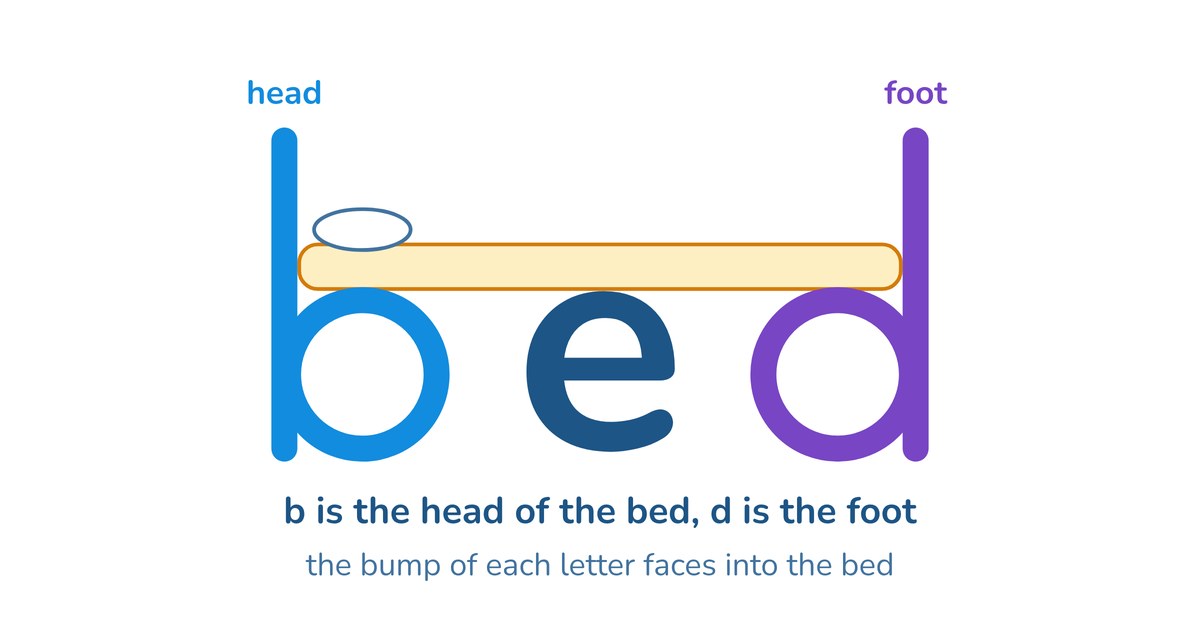
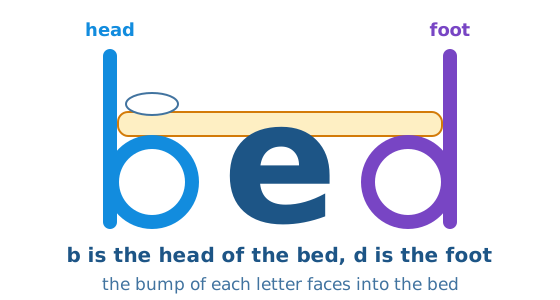
Make two fists and give a thumbs up with each hand, knuckles facing each other. Your left hand looks like a lower-case b, and your right hand looks like a d. Together they make a little bed, with b at the head and d at the foot, just like in the word bed. Children can do this under the desk or table as a silent check.
Teach one letter at a time
If b and d are both wobbly, focus on just one until it's solid. Many teachers start with b. Write it big, trace it, use it in words, and only once b is reliable bring d back in. Mixing them during practice can deepen the confusion.
Use the "c" clue for d
A lower-case d is a c with a tall line on the end. Because children usually learn c first, saying "start with a c, then go up tall and down" gives them a reliable way in. In the alphabet, c comes just before d, which some kids find a handy memory hook.
Link the letter to an anchor word
Choose one picture word for each letter and stick it somewhere visible, such as b for bat (with the bat drawn as the stick and the ball as the bump) or d for duck. When your child hesitates, they can check their anchor rather than guessing.
Feel the sound
Ask your child to say /b/ and /d/ with a hand in front of their mouth. For /b/, the lips press together and pop open. For /d/, the tongue taps just behind the top teeth. Linking the shape of the mouth to the shape of the letter gives them another clue to hold onto.
Helping with other reversals
Numbers. Keep a number line or a 0–20 chart on the fridge or the homework desk. Before writing a tricky number, your child can glance at the chart to see which way it faces, rather than relying on memory.
Was and saw. These two are tricky because they share all three letters. Encourage your child to put a finger under the first letter and say its sound before reading the word. "Starts with /w/: was." The same goes for on and no.
Mirror writing. If your child writes whole words or lines backwards, gently show them where to start on the page. A green dot or small sticker at the left margin ("start on green") is a simple visual reminder.
The handwriting connection
Correct letter formation is one of the most effective ways to reduce reversals over time. When a child always starts b with a tall stick from the top, then bounces back up into a round tummy, and always starts d with the c shape, the movement itself starts to carry the direction.
Each Australian state and territory has its own school handwriting font, so the exact shape and starting point taught at your child's school might differ a little from what you learned. Victoria, for example, uses Victorian Modern Cursive, while New South Wales uses NSW Foundation Style. Ask the teacher which style they use, or look at the alphabet strip in your child's classroom, so home practice matches school.
Short, frequent handwriting practice beats long sessions. A few minutes of writing letters in sand, shaving cream, or on a steamy bathroom mirror can make practice feel like play. If your child also seems to struggle with pencil grip, cutting or other fine-motor tasks, mention it to the teacher; occasionally an occupational therapist can help.
Letters and handwriting at school
The national Australian Curriculum: English (version 9) sets clear steps. Children in Foundation (Prep) are expected to recognise and name all upper- and lower-case letters and know the most common sound each one represents. They are also expected to form most lower-case and upper-case letters using learnt letter formations.
In Year 1, children write words using unjoined lower-case and upper-case letters. By Year 2, they're expected to write legibly and with growing fluency using unjoined letters.
That progression is a helpful guide for parents. In Prep, reversals are an ordinary part of learning letters. By the end of Year 2, letter formation should be fairly secure, though an occasional slip under pressure is still normal. The guides to Prep reading, reading milestones from Prep to Year 2 and Year 2 reading give a wider view of what to expect.
Things to avoid
Making a big deal of it. Constant correction can make a child anxious about writing at all. Pick your moments, and let small slips in a story go if the ideas are flowing.
Long worksheets of b and d. Page after page of mixed b/d words often makes things worse because the child practises confusing the two. Short, focused practice on one letter at a time works better.
Assuming it's laziness. A child who reverses a letter isn't being careless. Their brain is doing exactly what human brains are designed to do, and it takes time to override.
Comparing siblings or friends. Children develop at different rates. One child might stop reversing at five, another at seven, and both can turn into strong readers.
When to talk to the teacher
It's worth raising letter reversals with your child's teacher if:
- reversals are still frequent (not just occasional) after Year 2, or around age eight
- your child is also slow to learn letter sounds, or finds it hard to hear rhymes or break words into sounds
- reading progress seems to have stalled over several months
- there's a family history of reading difficulties
- writing is very slow, messy or uncomfortable compared with other children their age
Teachers see a lot of children and can tell you whether your child's reversals look typical. If there are wider concerns, the school might suggest a reading assessment, or a referral to a speech pathologist, educational psychologist or occupational therapist, depending on what's going on.
For more on next steps, see how to help a struggling reader, the guide to spotting if your child is behind in reading, and signs it's time to worry. If practice at home keeps turning into a battle, try the ideas in homework without tears.
FAQ
Is it normal for my child to write letters backwards?
Yes. Letter reversals are very common in Prep and Year 1 and usually fade during Year 2. Many children still reverse the occasional letter until around age seven or eight.
Does reversing b and d mean my child has dyslexia?
Not on its own. Most children who reverse letters don't have dyslexia. It's more useful to look at whether they're learning letter sounds, hearing sounds in words and making steady progress in reading.
How can I help my child stop mixing up b and d?
Use one or two strategies consistently, such as the bed trick, teaching one letter at a time, and practising the correct letter formation. Short, regular practice works better than long worksheets.
Try this tonight
Show your child the bed trick with your hands, then write bed together in big letters. Ask them to point to the head of the bed (b) and the foot of the bed (d). Tomorrow, see if they can make the bed with their hands without help.
Want a broader picture of your child's reading? Ziado's free check runs for about ten minutes at home and adapts as your child works through it, getting easier or harder to match their answers. Some first results show up as soon as it's done, with no account or card required, and you'll get the complete placement after signing up. It doesn't measure handwriting or count reversals, it isn't built for NAPLAN, and it can't diagnose dyslexia or any other learning difficulty. You can see what day-to-day practice looks like at Ziado reading. Whether you choose Individual or Family, there's a two-week free trial first; see pricing for current plans.
Wondering how your child is going with reading overall?
Ziado's free check is a one-off, roughly 10-minute adaptive diagnostic with partial results only - no account, no card. The full placement unlocks after signup.
Start the free reading check