Reading levels explained for parents (Australia)
The book bag comes home with a new reader and a sticker on the cover: a green dot, a number 12, maybe the letter H. At pick-up another parent mentions their child "just went up to Level 15", and suddenly you're wondering whether a 12 is good, bad or somewhere in between. Then the school report arrives with a reading level on it too, and nobody has explained what the number actually measures.
Reading levels are a way of grading books by how hard they are, and of matching a child to books they can read with a bit of support. They can be genuinely useful for teachers. They can also cause a lot of needless worry at home, especially when parents compare numbers in the playground.
Below you'll find the level systems used in Australian schools, how a teacher decides on a level, what "easy", "just right" and "hard" mean, why some schools now use levels less (or not at all) for beginners, and how to get the most out of whatever book comes home.
What is a reading level?
A reading level is a label that puts books in order of difficulty. A book at a higher level usually has more words on each page, longer sentences, less repetition, less picture support, harder vocabulary and more complex ideas.
When teachers talk about your child's level, they usually mean the level of book your child can currently read accurately and understand with a little help. It's a snapshot of one moment, worked out with one kind of book.
It is not an IQ score, a ranking against classmates, or a measure of how much your child enjoys reading.
The level systems Australian schools use
There's no single national system, which is part of the confusion. You might come across:
- PM levels (numbers 1 to 30), from the PM readers and PM Benchmark assessment kit. These have been very widely used in Australian and New Zealand primary schools.
- Colour bands that group the PM levels together, such as Red, Yellow or Blue.
- Letter levels (A to Z), from the Fountas & Pinnell system, sometimes called guided reading levels.
- Reading Recovery levels, numbered in a way that closely matches the early PM levels.
- A school's or publisher's own scheme, such as stages, phases or animal names.
Publishers produce charts that line their systems up against each other, but they always say the match is approximate. A "Level 16" in one series won't feel identical to a "Level 16" in another.
PM levels and colour bands
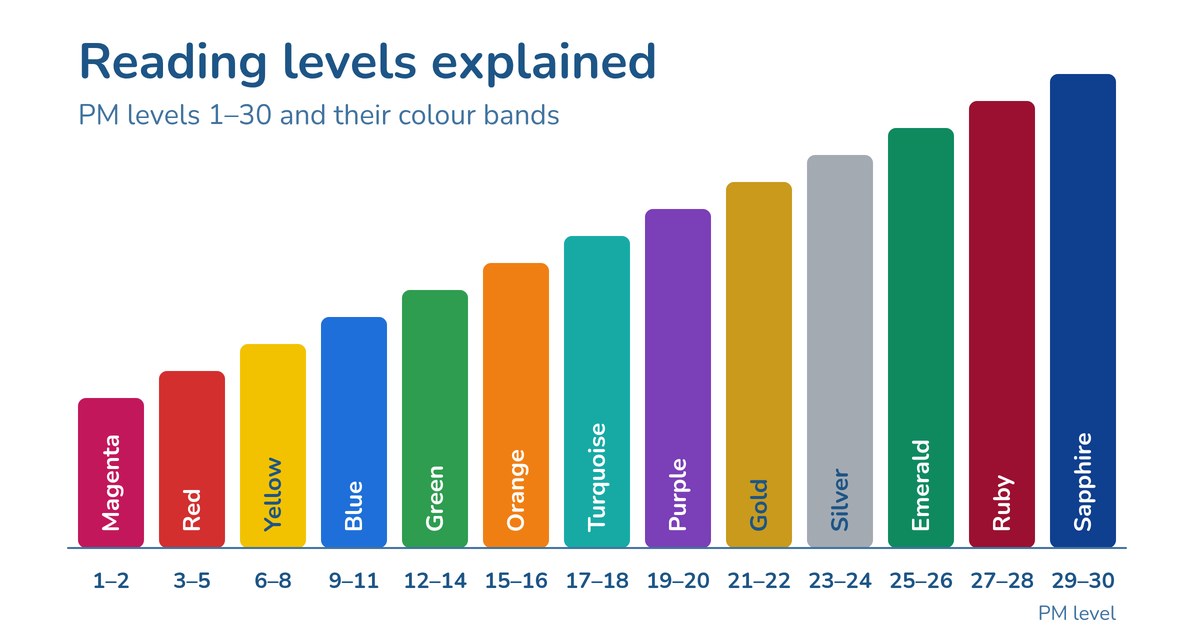
Because PM levels are so common in Australia, here's how the numbers group into colour bands:
| Colour band | PM levels |
|---|---|
| Magenta | 1–2 |
| Red | 3–5 |
| Yellow | 6–8 |
| Blue | 9–11 |
| Green | 12–14 |
| Orange | 15–16 |
| Turquoise | 17–18 |
| Purple | 19–20 |
| Gold | 21–22 |
| Silver | 23–24 |
| Emerald | 25–26 |
| Ruby | 27–28 |
| Sapphire | 29–30 |
Some schools adapt these bands slightly, and some publisher charts overlap neighbouring bands by a level. If the sticker on your child's book doesn't fit this table, ask the teacher which scheme the school follows.
You may also see charts online that pair each level with an age. Treat those carefully. Schools set their own expectations, and the right level for a particular child depends on far more than their birthday.
How a teacher works out a level
The traditional method is a running record. Your child reads a short book they haven't seen before, aloud, one-on-one with the teacher. As they read, the teacher marks every word: read correctly, misread, skipped, self-corrected or told.
The teacher then looks at three things:
- Accuracy. What percentage of words were read correctly?
- Self-correction. Did your child notice when something didn't make sense or didn't match the letters, and fix it?
- Understanding. Can your child retell the story or answer questions about it?
Many teachers also note fluency: whether the reading sounded smooth and expressive or slow and word-by-word. The reading fluency guide explains why that matters.
The level your child is given is usually the highest one where they read accurately and understood what they read.
Easy, just right and hard
Running records sort a book into one of three bands based on accuracy:
- Easy (independent): about 95% of words or more read correctly. Your child can read this alone.
- Just right (instructional): about 90 to 94% correct. A good level for learning with an adult nearby.
- Hard: below about 90%. Too many tricky words, and meaning starts to break down.
To picture it, on a page of 100 words, a "just right" book means roughly 6 to 10 words cause trouble. In a "hard" book, more than 10 do. That's a lot of stopping, and it's why a hard book can turn reading into a slog.
At home, a quick rule of thumb some families use is the five-finger test. Your child reads a page and puts up one finger for each word they can't read. None or one finger suggests an easy read; two or three, about right for reading with help; four or five, a book to share aloud for now.
What a level tells you, and what it doesn't
A level can tell you roughly which books will suit your child right now, and whether they've moved on since last term.
It can't tell you why a child is finding reading hard. Two children on the same level can have very different needs. One may have strong phonics but stumble on unusual words. Another may be guessing from the pictures and the first letter, which gets them through easy books but stops working as the pictures disappear. If that sounds familiar, see my child guesses words when reading.
A level also says little about vocabulary, background knowledge or understanding of longer texts, which matter more and more from Year 3 onward. The guide to reading comprehension strategies at home covers that side.
Levelled books and decodable books
Many parents grew up with levelled readers: books graded by overall difficulty, often with patterned sentences and strong pictures. Today many Prep and Year 1 children bring home decodable readers instead. These are built around the specific letter-sound patterns your child has been taught, so they can sound words out rather than guess.
Victorian Department of Education guidance for teachers describes the difference this way: decodable texts follow a phonics teaching sequence and are useful for practising blending, segmenting and fluency, while levelled texts lean on context, pictures and high-frequency words and are useful for teaching comprehension, grammar and vocabulary.
So the two types do different jobs. A decodable reader may have a "stage" or "set" number rather than a level, and a child can be on an early decodable set while reading well beyond it in other ways. The decodable readers guide explains how those books are sequenced, and phonics vs sight words covers the teaching approach behind them.
Why some schools use levels less for beginners
Over the past several years, Australian schools have put more weight on explicit, systematic phonics in the first years of school. NSW, South Australia and Victoria now run a Year 1 phonics check in government schools, which looks at whether children can decode real and made-up words. You can read more in our guide to the Year 1 phonics check.
The Australian Curriculum changed its wording to match. The older version expected Foundation children to read "decodable and predictable texts". Version 9 asks them to read "decodable and authentic texts using developing phonic knowledge", dropping the predictable, patterned books from that line.
As a result, some schools no longer use PM levels or running records for beginning readers, and track phonics knowledge instead. Others still use levels throughout primary school, often alongside phonics assessment. Both are common, so if your child's books don't have levels, nothing is missing.
"My child is stuck on the same level"
Plateaus are very common, and they're not usually a sign that something is wrong. Some reasons:
- The jumps get bigger. Moving from one early level to the next can happen in weeks. Higher up, books get longer and the step between levels takes more time.
- New skills are needed. Around the middle levels, books rely less on patterns and pictures. A child who leaned on those clues has to decode more carefully, which can feel like going backwards.
- Understanding is the hold-up. Some children read the words accurately but can't retell the story, so the teacher waits.
- Assessment timing. Many schools only formally reassess a few times a year.
If several months pass without movement, ask the teacher what specifically is holding your child at that level, and what you can do at home.
When the book seems too easy or too hard
Too easy? That's often deliberate. Rereading a familiar, comfortable book builds speed, expression and confidence. Ask your child to read it like a newsreader, or to do the voices. The robot reading guide has ideas for smoothing out choppy reading.
Too hard? Don't battle through it. Read it to your child first, then share the reading, then let them try a page. Let the teacher know too: a short note in the reading diary is enough. A book that's too difficult every night can quietly put children off reading, which is the subject of my child hates reading.
Getting the most from the book bag
A few minutes of good-quality reading beats a long, tense session. Try this pattern:
- Before: Look at the cover and title. What might happen? Are there any tricky words to spot first?
- During: When your child gets stuck, give them time. Then prompt them to look at the letters and sound the word out, rather than guessing from the picture. If they're still stuck, tell them the word and move on.
- After: Ask them to tell you what happened, or what they found out. Talk about one new word.
- Again: Reread it the next night. Second reads are usually smoother, and that's the point.
Keep your own reading aloud going, too. Books above your child's level are where they meet rich vocabulary and bigger ideas, and listening to you read is good practice for understanding. The guide to vocabulary while reading has simple ways to talk about new words.
Choosing library books without a level sticker
Library and bookshop books rarely have levels, and that's fine. Let your child choose books they're interested in, then use the five-finger test to decide whether they'll read it alone, with you, or listen while you read. A mix of all three is ideal.
Questions to ask the teacher
- Which level system does the school use, and how often is it checked?
- Is the take-home book at an easy or a just-right level?
- What's the next skill my child is working on?
- Are there phonics patterns we should practise at home?
- How does my child's reading compare with what you'd expect at this time of year?
The last question gives you a far better picture than comparing numbers with other families. School reports may also include levels or reading descriptors; the guide to school report cards explains how to read them.
For a broad picture of typical progress, see reading milestones from Prep to Year 2, what Year 2 reading covers and Year 3 reading.
Signs it's worth a conversation
A lower level than a friend's child isn't a reason to panic. It is worth talking to the teacher if:
- your child's level hasn't moved for two or more terms
- they read the words but can rarely tell you what happened
- most unfamiliar words still get a guess based on the picture or the opening letter
- reading time regularly ends in tears or refusal
- you've been told they're below the expected level and you're not sure what the plan is
To plan next steps, start with how to tell if your child is behind, check the signs that call for a closer look, or pick up practical ideas for helping a struggling reader.
FAQ
What reading level should my child be at?
There's no single answer, because schools use different systems and set their own expectations. The most useful question is whether your child is making steady progress, and what their teacher expects at this point in the year.
What does PM level mean?
PM levels are a number scale from 1 to 30 used with the PM readers and PM Benchmark assessments, which many Australian schools use. Higher numbers mean longer, more complex books. Levels are grouped into colour bands such as Red, Blue and Gold.
Why doesn't my child's school use reading levels?
Many schools now focus on systematic phonics for beginners and use decodable readers matched to the sounds taught, tracking phonics skills rather than book levels. Some still use levels later in primary school.
Should I buy books at my child's level?
You can, but it isn't necessary. A mix of easy books to read alone, just-right books to read together, and harder books you read aloud works well.
Before the next book bag comes home
Next time a reader comes home, try the five-finger test on the first page together. Then ask your child which pile they think it belongs in: "I can read this myself", "Let's read it together" or "You read it to me". It turns the level into something they understand, rather than a number to worry about.
If you'd like to know more about your child's reading than a book level can show, the Ziado free check is an online activity of about ten minutes your child completes at home. It changes as they go, offering easier or harder questions depending on their answers. Early results appear at the end with no account or card needed; creating an account unlocks the whole placement. You won't get a PM level from it, it doesn't replace the school's own assessment, it's not aimed at NAPLAN, and it can't identify a reading difficulty. For a look at everyday practice, visit Ziado reading. Both plans, Individual and Family, open with a two-week free trial; see pricing for current options.
Want a fuller picture of your child's reading?
Ziado's free check is a one-off, roughly 10-minute adaptive diagnostic with partial results only - no account, no card. The full placement unlocks after signup.
Start the free reading check