Cube numbers explained for parents (Australia)
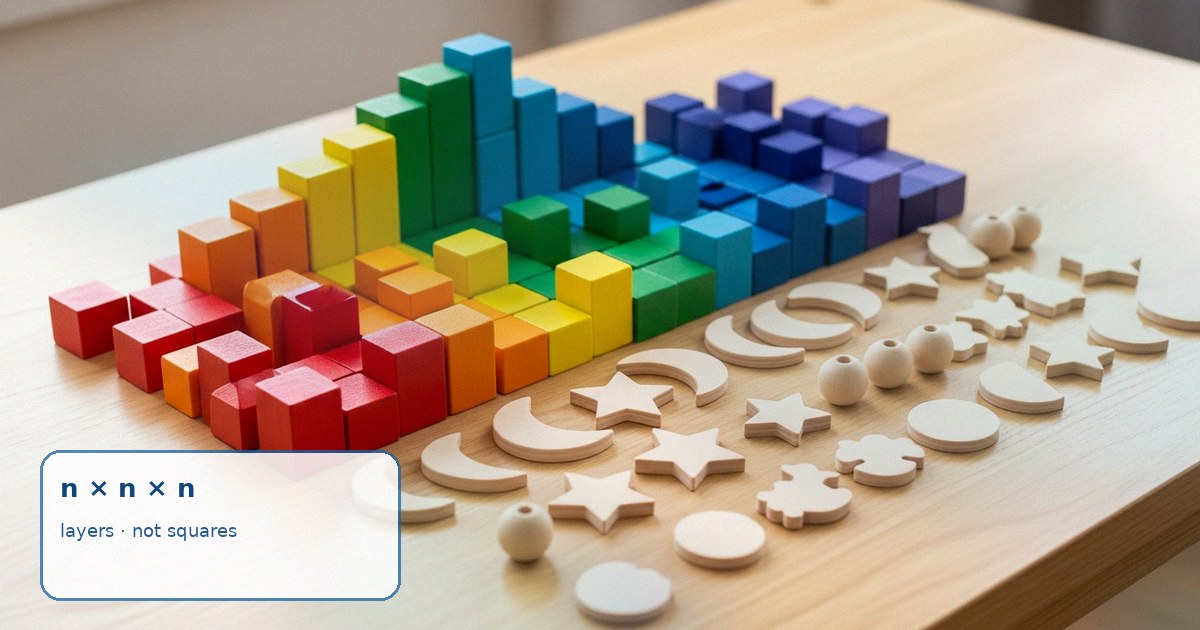
Homework says 1, 8, 27, 64… or 3³ and Australian parents wonder whether that is a volume formula, a times-table chant, or something else. In primary classrooms, a cube number is a number you get when you multiply a whole number by itself three times - n × n × n - so 2 × 2 × 2 = 8, 3 × 3 × 3 = 27. Teachers often show it first with unit cubes stacked into a bigger cube before they write 3³ or talk about "cubed".
This guide owns the cube-number meaning and patterns teach-through for Year 5–Year 6 (Year 4 lightly via square numbers and 3D shapes): little cubes before symbols, the sequence 1, 8, 27, 64…, contrast with square numbers (n × n / flat array), a light volume link after packing, and calm home practice. Not a square-numbers or volume-formula deep dive, not factors algebra, and not an exponents course. Year maps: Year 4–Year 6 maths.
What a cube number means
A cube number = the product of a whole number multiplied by itself three times (n × n × n).
Examples children meet early:
- 1 × 1 × 1 = 1
- 2 × 2 × 2 = 8
- 3 × 3 × 3 = 27
- 4 × 4 × 4 = 64
- 5 × 5 × 5 = 125
- 6 × 6 × 6 = 216
- 7 × 7 × 7 = 343
- 8 × 8 × 8 = 512
- 9 × 9 × 9 = 729
- 10 × 10 × 10 = 1000
Teachers may say cube number, cubic number, "n cubed", or "how many little cubes make this bigger cube?". Echo the class phrase. The picture is a cube built from equal layers: each layer is an n-by-n square of unit cubes, and there are n layers. The number sentence is n × n × n. The little superscript ³ (when it appears) is a shorthand for that - not a new operation to fear.
Unit cubes and layers before symbols
Abstract 4³ = 64 lands better after a cube children can build and count:
Building blocks or multilink cubes. Make a 3-by-3 square base (9 little cubes). Stack two more matching layers on top. Count: 3 layers × 9 = 27. Say "three cubed" only after the solid is there. Equal piles and rows language: equal groups, arrays.
Sugar cubes or Lego stud-aligned bricks. Build a 2×2×2. Count aloud: "two along, two across, two high - eight little cubes." Write 2 × 2 × 2 = 8 underneath. Multiplication meaning: multiplication explained.
Sketch then check. Draw a cube outline and mark the edges as "3". Ask: "How many little cubes would fill it if each edge is 3?" Build or imagine layers before trusting the written product.
Keep materials short. The written cube records the packing; chanting 1, 8, 27, 64 without a model often turns into rote noise.
Cube numbers vs square numbers (clear contrast)
Parents often meet both lists in the same week. Keep the pictures different:
| Idea | Picture | Number sentence | Example |
|---|---|---|---|
| Square number | Flat square array (rows = columns) | n × n | 3 × 3 = 9 |
| Cube number | Solid cube of unit cubes (n layers of n×n) | n × n × n | 3 × 3 × 3 = 27 |
Same starting number, different dimensions. A square number answers "how many tiles in an n-by-n flat square?". A cube number answers "how many little cubes make an n-by-n-by-n bigger cube?". Full square teach-through: square numbers explained. Do not drill both lists as one chant.
Not the same as volume formulas (or factors)
Cube numbers use multiplication three times - often after packing unit cubes - but this page owns the cube number idea, not volume-formula coaching or factors fluency.
- Volume explained - space inside a 3D shape; packing unit cubes; rectangular prism L×W×H lightly after concrete packing. When the solid is a cube with equal edges, the packed count is a cube number - link, do not duplicate the volume teach-through.
- Surface area explained - wrapping / faces of a solid; light cousin when homework mentions cubes.
- 3D shapes explained - naming solids / faces / edges / vertices; cube as a shape before cube numbers.
- Square numbers explained - n × n / flat arrays (contrast above).
- Multiplication, arrays, equal groups - × meaning and pictures that make n × n × n sensible.
- Factors and multiples - what divides evenly / skip patterns; cube numbers may appear as a light pattern cousin without replacing that page.
At home: (1) build or sketch one small cube of unit cubes; (2) count layers; (3) write n × n × n; (4) name it as a cube number. If volume packing wobbles sit underneath, warm that on the volume page, then return to one cube number.
Oral check: "how many little cubes make this bigger cube?"
Before symbols, the calm question is oral:
- Show (or sketch) a cube with edge 2: "How many little cubes make this bigger cube?" → 8
- Edge 3 → 27
- Edge 4 → 64
Children can answer by building, by counting layers (n layers of n×n), or - when ready - by calculating n × n × n. Stay with whole-number edges children meet in primary. Do not push calculator cube roots, algebra, or secondary solid formulas.
Patterns children notice
Once a few cubes are built, invite noticing - not a lecture:
The sequence grows fast. From 1 → 8 → 27 → 64 → 125. Children do not need a formula - they can see each new edge adds many little cubes.
Square face first, then stack. Many children naturally build one n×n layer (a square number of cubes) then stack n layers. That bridge is useful: square numbers feed cube numbers without merging the two ideas. Link lightly to square numbers.
Same edge, different meaning. Edge 4: square number 16 (flat); cube number 64 (solid). Say both sentences aloud so they do not blur.
Year by year: where cube numbers show up
Year 4 - solid 3D shapes, stronger square numbers and multiplication; cube numbers may be light or informal (Year 4 maths; AC Year 4).
Year 5 - clearer naming of cube numbers, packing unit cubes, linking to early volume ideas (Year 5 maths; AC Year 5).
Year 6 - confident cube numbers in patterns and light powers where the class goes; volume packing for prisms beside cube special cases (Year 6 maths; AC Year 6). Still not a secondary exponents course.
Australian Curriculum Mathematics (version 9) builds multiplicative and measurement thinking here. At home: one carefully packed cube beats a page of silent ³ drills.
Home games that do not feel like worksheets
Build then name. Multilink or Lego: make 2×2×2 and 3×3×3; say the cube number; write n × n × n.
Layer count. Build one square layer; stack matching layers until height matches the edge; count total little cubes.
Square or cube? Call a number from mixed lists (9, 8, 16, 27, 25, 64). Is it a square number, a cube number, both (e.g. 64 = 8² and 4³), or neither? Soft link to square numbers.
How many little cubes? Sketch or show a cube edge; child answers orally before calculating.
Pack then link volume. After one cube is packed, ask "is that the space inside?" - light door to volume explained, then stop. Do not open cylinder/cone formulas.
Keep games under ten minutes. Evenings fray: homework without tears.
A simple weekly home routine
- Two minutes of meaning - build or sketch one small cube of unit cubes; say n × n × n.
- Five minutes of pattern - extend the sequence one step, or play "square or cube?" with a short list.
- Three minutes of a check - "how many little cubes make a bigger cube with edge ___?" or rebuild yesterday's cube from memory.
Stop while friendly. Volume packing and square-number fluency sit on their own pages - this page owns cube numbers.
Common mix-ups (and kinder fixes)
Treating cube numbers as square numbers. Rebuild: flat n×n vs solid n×n×n. Say both sentences. Full square page: square numbers.
Chanting 1, 8, 27, 64 with no model. Drop the list for a day; only pack unit cubes.
Confusing "cube" the shape with "cube number". Hold a cube solid (3D shapes); pack it with little cubes; name both calmly.
Jumping to volume formulas before packing. Count little cubes first; L×W×H for rectangular prisms lives on volume after concrete packing - not as a shortcut past building.
Blaming cube numbers when × facts are shaky. Warm n × n first if needed (multiplication, square numbers), then multiply by n again for the third factor.
Jumping to ∛ on a calculator. Stay with whole-number "what edge makes this many little cubes?" questions.
Tears over a worksheet of ³ symbols. One carefully packed cube beats a page of crosses - homework without tears, maths anxiety.
Wider worry: Is my child behind in maths?; calm signals: when to worry about maths.
How this links to other guides
- Square numbers explained for parents - n × n / flat arrays (clear contrast)
- Volume explained for parents - space inside after packing unit cubes
- Surface area explained for parents - wrapping / faces of solids
- 3D shapes explained for parents - cube as a solid before cube numbers
- Multiplication explained for parents - × umbrella
- Arrays explained for parents / Equal groups explained for parents - pictures that support layers
- Factors and multiples explained for parents - light pattern cousin only
- Year 4–Year 6 maths (Year 5)
- Maths Help hub - more parent guides
Ask the teacher: "For cube-number homework, should we echo unit cubes and n × n × n at home before the ³ symbol?"
FAQ
What is a cube number?
A number made by multiplying a whole number by itself three times (n × n × n) - for example 3 × 3 × 3 = 27. It matches packing an n-by-n-by-n cube with unit cubes.
What are the first cube numbers?
1, 8, 27, 64, 125, 216, 343, 512, 729, 1000… (from 1×1×1 through 10×10×10). Classes often stay with smaller edges first.
How is a cube number different from a square number?
A square number is n × n (flat square array). A cube number is n × n × n (solid cube of unit cubes). Same n, different pictures.
When do Australian children meet cube numbers?
Often more formally in Year 5–Year 6, with Year 4 light bridges via square numbers and 3D shapes. Follow the class method.
Does this page teach volume or square numbers?
No - those skill pages own packing/space-inside and n × n. This page owns cube-number meaning and patterns, with light links out.
A calm next step
When unit cubes come before symbols, 1, 8, 27, 64… feels familiar, and "how many little cubes make this bigger cube?" lands calmly - and you want a wider number-skill snapshot at home - Ziado's free check is a one-off, roughly 10-minute adaptive diagnostic with partial results only - no account and no card. The full placement unlocks after signup. It is not NAPLAN practice and it is not the full product; Ziado's ongoing path is adaptive maths (Foundation–Year 6) plus phonics reading (Foundation–Year 4). Explore Ziado maths for practice that can meet multiplication ideas at the right step. Individual and Family plans, if you continue later, start with a 14-day free trial of the full app — see pricing for current plans.
Curious where cube numbers sit for your child?
Ziado's free check is a one-off, roughly 10-minute adaptive diagnostic with partial results only - no account, no card. The full placement unlocks after signup.
Start the free maths check