Volume explained for parents (Australia)
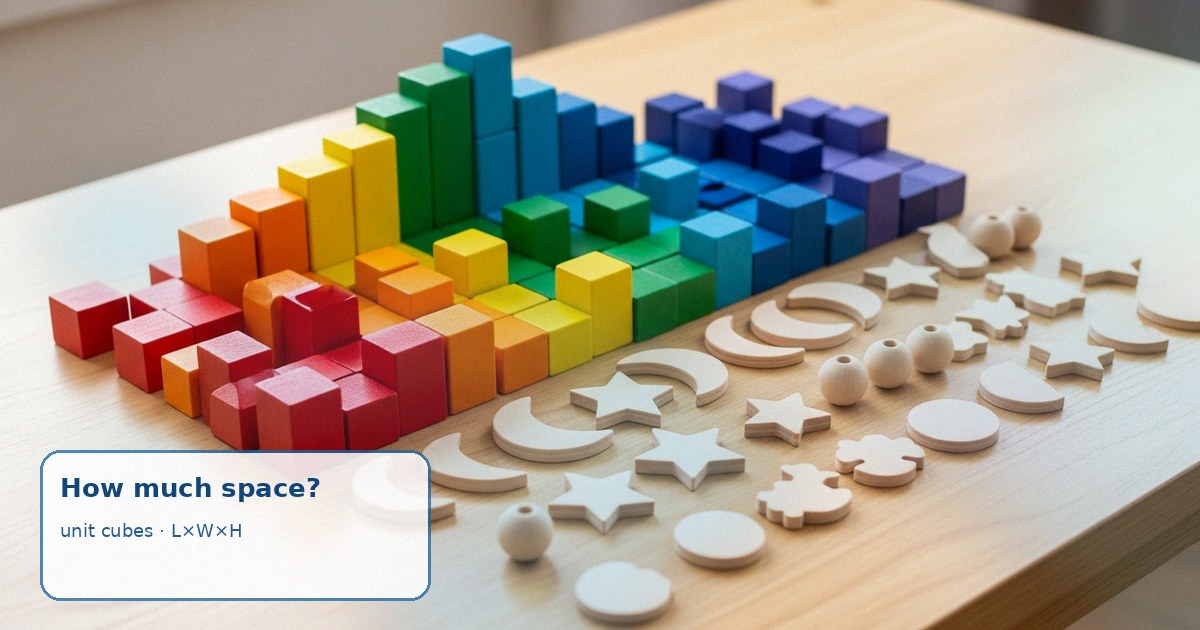
Homework says find the volume, how many cubes fill the box?, or volume in cubic centimetres - and Australian parents reach for kitchen pouring language from an earlier year. In upper primary, volume usually means the space inside a 3D shape: packing unit cubes, naming cubic centimetres (cm³), and only later a light length × width × height shortcut for a rectangular prism. Oral "how many cubes fill it?" usually comes before the formula.
This guide owns volume as space inside for Year 5–Year 6 (Year 4 light 3D bridge): packing unit cubes; cubic centimetres; rectangular prism L×W×H lightly after concrete packing; and clear contrast with capacity (liquid a container holds) and area (flat surface). Liquid capacity: capacity and volume explained (live). Fence vs fill: area vs perimeter (live). Naming solids: 3D shapes explained (live). Year maps: Year 4–Year 5–Year 6 maths. Not capacity pouring, area-vs-perimeter, 3D naming, mass/length deep dives, or cylinder / cone / sphere formulas.
The big idea: space inside a 3D shape
Volume asks: how much space is inside this solid?
- A tissue box filled with sugar cubes (or linking cubes) - count how many fit.
- A drawing of a rectangular prism built from unit cubes - count the cubes, or find a pattern in layers.
- Later: the same box measured in centimetres, then named in cubic centimetres.
Spoken classroom phrases: volume, cubic centimetres, cm³, unit cubes, pack, fill, layers, length × width × height (when ready). Echo the class words. Volume is space inside - not how heavy, and not how much milk a jug holds as the main job.
At home: build a small open box from scrap card, fill it with identical cubes (or sugar cubes), and ask, "How many cubes fill it?" One honest pack beats a page of silent L×W×H ticks.
Oral first: how many cubes fill it?
Many Australian classrooms start with concrete packing before centimetre formulas:
- "How many cubes fill it?" → pack, count, say the number aloud.
- "How many in one layer? How many layers?" → arrays thinking in three dimensions.
- "If each cube is 1 cm³, what is the volume?" → unit cubes → cubic centimetres.
Example: a box holds 2 cubes along the front, 3 along the side, and 4 layers high. Oral: "Two by three is six in a layer; four layers make twenty-four cubes." Only then write 2 × 3 × 4 = 24 cm³ if the class uses centimetre cubes.
Use the oral cue when homework appears. It separates jobs children mix up:
- Pack and count the space inside (this page's volume thread).
- Read how much liquid a jug holds (mL / L) - that capacity thread lives on capacity and volume explained.
- Cover a flat face with squares - that area idea lives on area vs perimeter.
Packing meaning first; centimetre shortcuts later.
Unit cubes and cubic centimetres
A unit cube is the building block: one cube stands for one cubic unit. When each edge of that cube is 1 centimetre, the unit is a cubic centimetre (cm³).
- 1 cm × 1 cm × 1 cm cube → 1 cm³.
- A solid made of 12 such cubes → volume 12 cm³.
- Teachers may also say cubic units when the cubes are not centimetre-sized - still pack and count.
Australian Curriculum Mathematics (version 9) builds volume of rectangular prisms with cubic centimetres across upper primary (Year 5–Year 6). Match the cubes and language the class uses.
Light length tip: centimetre edges sit beside length and distance explained (live) - this page owns the cubic step.
At home: with centimetre cubes, build 2 × 2 × 2 and say "eight cubic centimetres." With larger linking cubes, pack and count as cubic units until school uses cm³.
Rectangular prism L×W×H - after packing
When packing is firm, teachers introduce a shortcut for a rectangular prism (cuboid / box shape):
Volume = length × width × height
Only after children can see why: length × width gives cubes in one layer; multiply by height (number of layers). That is the same idea as arrays and multiplication - light links to arrays explained and multiplication explained (live).
- Measure (or count) edges in centimetres when the class does.
- Multiply in the order the teacher models.
- Check with a quick oral pack: "Does that match how many cubes would fit?"
Shape naming (cuboid vs rectangular prism, faces, edges, vertices) stays on 3D shapes explained. This page owns how much space is inside, not the name quiz.
Skip cylinder, cone, and sphere volume formulas here - those are secondary / later-years territory. A calm "later years" note is enough if a sheet flashes π.
Capacity vs volume (and vs area)
Parents hear capacity and volume used loosely in early years. Upper primary usually separates them more carefully:
| Idea | Question | Typical units | Guide |
|---|---|---|---|
| Volume | How much space inside this solid? | cm³, unit cubes | This page |
| Capacity | How much liquid can this container hold? | mL, L | Capacity and volume (live) |
| Area | How much flat surface? | cm², square units | Area vs perimeter (live) |
A water bottle can hold 600 mL (capacity) and the shell also takes up space (volume) - related ideas, different homework jobs. Question words: cubes, cm³, pack → here; holds, pour, mL, L → capacity guide; cover, cm², fence → area vs perimeter.
Mass (heavy, grams): light tip to mass and weight (live). Flat names: 2D shapes (live).
Not the same as capacity, area, or 3D-shape names
This page owns space inside / unit cubes / cm³ / L×W×H after packing / oral how many cubes fill it? - not those deep dives.
- Capacity and volume (live) - pouring, mL / L.
- Area vs perimeter (live) - fence vs fill on flat shapes.
- 3D shapes (live) - cube, cuboid, faces / edges / vertices.
- Length and distance / mass and weight (live) - light cousins only.
- Multiplication / arrays (live) - layers and L×W×H meaning.
At home: (1) pack and count; (2) name cm³ when cubes are centimetre-sized; (3) then multiply L×W×H. Skip cylinder / cone / sphere formulas.
Year by year: where volume shows up
Year 4 (light bridge) - firmer 3D noticing and informal "how much space" with cubes; formal cm³ and L×W×H may wait (Year 4 maths; AC Year 4). Shape foundations: 3D shapes. Pouring capacity: capacity and volume.
Year 5 - packing rectangular prisms with unit cubes; cm³; layers; L×W×H when packing is secure (Year 5 maths; AC Year 5).
Year 6 - fluent pack → cm³ → L×W×H; richer estimate-and-calculate problems; still not cylinder formulas here (Year 6 maths; AC Year 6).
At home: one correct packed box beats a page of empty formula ticks.
Home games that do not feel like worksheets
Open box pack. Fill a small open box with identical cubes; count; say cubic units or cm³.
Layer story. Build one layer (2 × 3), stack identical layers; ask "how many layers?" before multiplying.
Centimetre cube tower. With 1 cm cubes, build 3 × 3 × 3 and say "twenty-seven cubic centimetres."
Estimate then pack. Guess how many fit one layer; pack to check.
Sheet check. On a drawn prism, count one layer and layers, then (if ready) multiply L×W×H and compare.
Keep games under ten minutes. If evenings fray - homework without tears.
A simple weekly home routine
- Two minutes of oral - one "how many cubes fill it?" with a real or drawn box; no formula yet.
- Five minutes of packing / layers - one rectangular prism; count a layer, then layers; say the total.
- Three minutes of cm³ or L×W×H (when ready) - one pack-then-multiply check; tip to multiplication / arrays if layers stick; tip to capacity and volume only for jug / mL sheets.
Stop while friendly. Foundations: 3D shapes; Year 4–6 maps above.
Common mix-ups (and kinder fixes)
Calling every jug question "volume" and every cube pack "capacity." Fix: cubes / cm³ / pack → here; holds / pour / mL / L → capacity and volume.
Jumping to L×W×H before packing. Fix: pack one layer, count layers, then multiply.
Treating volume like area. Flat cover is area (area vs perimeter); space inside is volume.
Turning the night into a 3D-name quiz. Faces / edges / vertices: 3D shapes; keep packing here.
Drilling cylinder or sphere formulas in Year 5. Keep rectangular-prism packing; later shapes can wait.
Tears over a long volume worksheet. Three careful packs beat twenty rushed ticks - homework without tears, maths anxiety.
Wider worry: Is my child behind in maths?; calm signals: when to worry about maths.
How this links to other guides
- Capacity and volume explained for parents - liquid capacity / mL / L (live; not this page's deep dive)
- Area vs perimeter explained for parents - fence vs fill on flat shapes (live)
- 3D shapes explained for parents - naming solids (live)
- 2D shapes explained for parents - flat faces cousin (live)
- Length and distance explained for parents - centimetre edges (live; light tip)
- Mass and weight explained for parents - heavy / grams (live; light tip)
- Multiplication / Arrays - layers and L×W×H meaning (live)
- Year 4–Year 6 maths (Year 5)
- Maths Help hub - more parent guides
Ask the teacher: "For volume homework, should we pack unit cubes and say cubic centimetres before we use length × width × height?"
FAQ
What is volume in primary school?
Space inside a 3D shape - often packing unit cubes and naming cubic centimetres (cm³).
How is volume different from capacity?
Volume = space inside (cubes / cm³). Capacity = liquid a container holds (mL / L). Detail: capacity and volume explained.
When do we use length × width × height?
After packing: one layer × number of layers for a rectangular prism. Pack first; multiply second.
What is a cubic centimetre?
A cube with 1 cm edges (cm³). Twelve such cubes → 12 cm³.
Does this page teach cylinder or sphere volume?
No - leave those for later years. This guide stays with packing and rectangular prisms.
When do Australian children meet volume this way?
Unit-cube packing and cm³ typically strengthen across Year 5–Year 6, with a Year 4 3D bridge. Follow the class method.
A calm next step
When packing unit cubes comes before the formula, cubic centimetres name the space inside, and capacity stays about liquid holds - and you want a wider measurement snapshot at home - Ziado's free check is a one-off, roughly 10-minute adaptive diagnostic with partial results only - no account and no card. The full placement unlocks after signup. It is not NAPLAN practice and it is not the full product; Ziado's ongoing path is adaptive maths (Foundation–Year 6) plus phonics reading (Foundation–Year 4). Explore Ziado maths for practice that can meet measurement and number skills at the right step. Individual and Family plans, if you continue later, start with a 14-day free trial of the full app — see pricing for current plans.
Volume packs the inside; covering the outside sits in surface area for parents.
Volume packs space; unit-cube layers as numbers sit in cube numbers for parents.
Volume is space inside a solid; metric rename (mL/L, cm/m) sits in converting units for parents.
Volume is space inside; the flat pattern that folds into the box is a net for parents.
Curious where volume sits for your child?
Ziado's free check is a one-off, roughly 10-minute adaptive diagnostic with partial results only - no account, no card. The full placement unlocks after signup.
Start the free maths check