Fractions, decimals and percentages explained for parents (Australia)
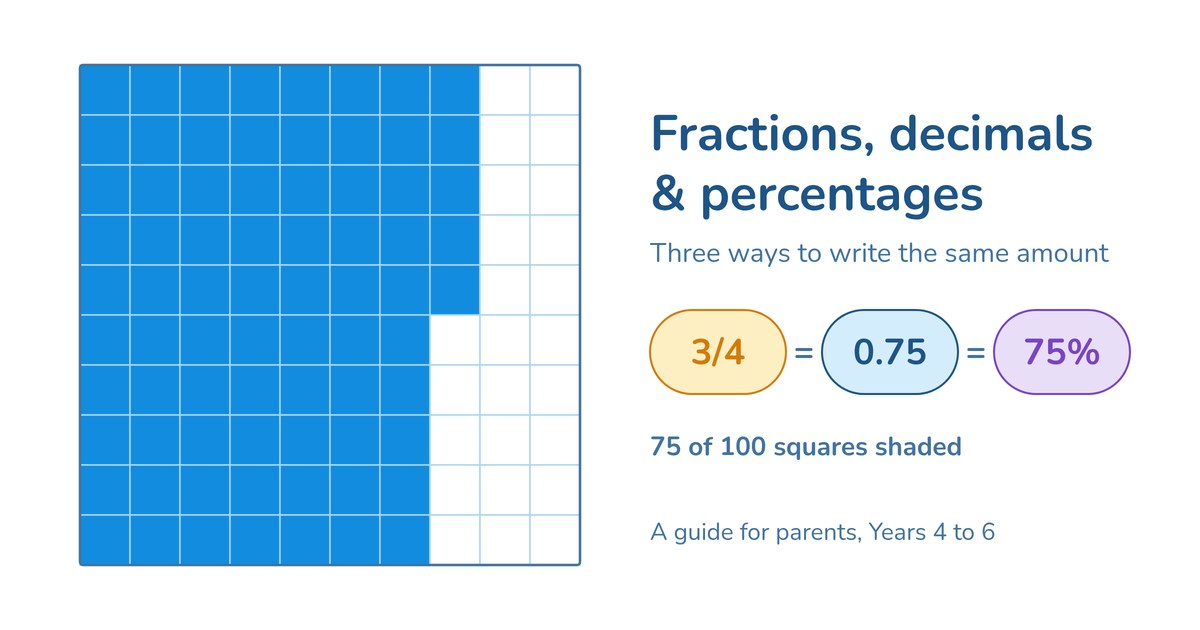
Your Year 5 child is staring at a worksheet with three columns headed Fraction, Decimal and Percentage. One box in each row is filled in and the other two are empty. The first row says ¾. You know the answer is 0.75 and 75%, but when they ask why, you realise you've never had to put it into words.
That's the heart of this topic. Fractions, decimals and percentages aren't three separate pieces of maths. They're three ways of writing the same amount, a bit like saying "half past three", "3:30" and "thirty minutes after three o'clock". Once your child sees that, converting between them becomes a matter of choosing the most convenient outfit for a number rather than memorising three sets of rules.
This guide walks through what each form means, the conversions children learn at school (with worked examples), a table of the equivalents worth knowing by heart, how to compare and order mixed forms, where the topic sits in the Australian Curriculum, the slip-ups that come up again and again, and some easy ways to practise using things already in your house.
One amount, three ways of writing it
Picture a chocolate block with 10 equal pieces, and your child eats 3 of them. They've eaten:
- 3/10 of the block, as a fraction (3 parts out of 10 equal parts)
- 0.3 of the block, as a decimal (3 tenths, written using place value)
- 30% of the block, as a percentage (30 out of every 100)
The amount of chocolate hasn't changed. Only the notation has.
Each form has a job it does best. Fractions are handy for sharing and for amounts like thirds that don't split neatly into tens. Decimals sit comfortably with money, measuring and calculators. Percentages make comparison easy, because every amount is scaled to the same "out of 100", which is why they turn up on sale signs, test results and phone batteries.
If the basics of any one form feel shaky, it helps to firm that up first. The guides to fractions, decimals and percentages each start from the beginning.
The secret ingredient: tenths and hundredths
Nearly every conversion children meet in primary school runs through tenths or hundredths. That's because decimals are built on place value: the first digit after the decimal point counts tenths, the second counts hundredths.
So a fraction with 10 or 100 on the bottom converts almost instantly:
- 7/10 = 0.7
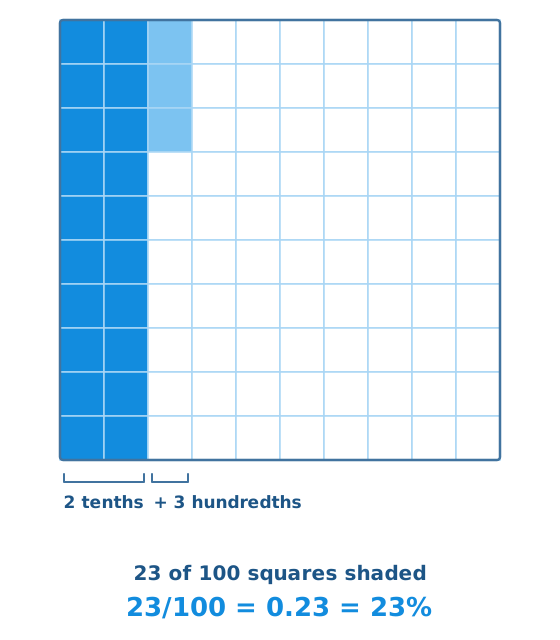
- 23/100 = 0.23
- 9/100 = 0.09 (nine hundredths, so the 9 sits in the hundredths column with a zero holding the tenths place)
And because "per cent" literally means "for each hundred", any number of hundredths is already a percentage in disguise. Twenty-three hundredths is 23%. Nine hundredths is 9%.
A 10 × 10 square of grid paper is the best picture for this. Shade 23 small squares and your child can see 23/100, 0.23 and 23% at once. Shade a whole column of 10 and they see 1/10, 0.1 and 10%. Many classrooms use exactly this model, sometimes called a decimat or hundred square.
Turning a fraction into a decimal
There are two main methods, and children usually learn them in this order.
Method 1: make the bottom number 10 or 100
If the denominator (bottom number) goes neatly into 10 or 100, multiply the top and bottom by the same number to get an equivalent fraction:
- 2/5: multiply top and bottom by 2 to get 4/10, which is 0.4
- 3/4: multiply top and bottom by 25 to get 75/100, which is 0.75
- 7/20: multiply top and bottom by 5 to get 35/100, which is 0.35
- 3/25: multiply top and bottom by 4 to get 12/100, which is 0.12
Some fractions need simplifying first. 6/30 doesn't scale to 100 neatly, but it simplifies to 1/5, which is 2/10, or 0.2.
Method 2: divide the top by the bottom
A fraction bar also means "divided by". So 3/8 is the same as 3 ÷ 8. Using short or long division, with zeros added after the decimal point, you get 0.375.
This method works for every fraction, including the awkward ones. Try 1/3: 1 ÷ 3 = 0.3333… with the 3s carrying on forever. Mathematicians call that a recurring decimal and sometimes write it with a dot over the 3. Year 6 children often meet this when they type 1 ÷ 3 into a calculator and are surprised the screen fills up. Upper primary students usually just round it, to 0.33 or 0.333. If your child wants to understand the remainders that keep appearing, this is a lovely example to explore.
Turning a decimal into a percentage
A percentage counts hundredths, so the question is simply "how many hundredths is this?"
- 0.35 is 35 hundredths, so 35%
- 0.4 is 4 tenths, which equals 40 hundredths, so 40% (not 4%)
- 0.05 is 5 hundredths, so 5%
- 0.125 is 12.5 hundredths, so 12.5%
- 1.2 is 120 hundredths, so 120%
The shortcut is to multiply by 100, which moves every digit two places to the left. There's a separate guide on why digits shift when you multiply or divide by powers of ten, which explains why digits move rather than the decimal point "hopping". Going the other way, divide by 100: 64% becomes 0.64, and 8% becomes 0.08.
Turning a percentage into a fraction
Write the percentage over 100, then simplify if you can:
- 40% = 40/100 = 2/5
- 75% = 75/100 = 3/4
- 15% = 15/100 = 3/20
- 12.5% = 12.5/100, and doubling top and bottom until there are no decimals gives 125/1000, which simplifies to 1/8
Children who know their factors and multiples find the simplifying step much quicker, because they can spot the biggest number that divides both parts.
Equivalents worth knowing by heart
Primary children aren't expected to convert every fraction on the spot. A short list of "friendly" equivalents covers most homework, shopping and test questions:
| Fraction | Decimal | Percentage |
|---|---|---|
| 1/2 | 0.5 | 50% |
| 1/4 | 0.25 | 25% |
| 3/4 | 0.75 | 75% |
| 1/5 | 0.2 | 20% |
| 2/5 | 0.4 | 40% |
| 1/10 | 0.1 | 10% |
| 1/8 | 0.125 | 12.5% |
| 1/3 | 0.333… | 33⅓% (about 33%) |
| 2/3 | 0.666… | 66⅔% (about 67%) |
| 1/100 | 0.01 | 1% |
| 1 | 1.0 | 100% |
Notice the chains that link them. Halve 1/2 and you get 1/4; halve again for 1/8. The decimals follow: 0.5, 0.25, 0.125. So do the percentages: 50%, 25%, 12.5%. Pointing out that pattern means your child only has to remember the first one.
Comparing and ordering mixed forms
A favourite upper-primary question gives a list like 3/5, 0.58, 61% and asks for the largest.
The trick is to convert everything into the same form. Percentages are usually easiest:
- 3/5 = 6/10 = 60%
- 0.58 = 58%
- 61% stays as it is
So the order from smallest to largest is 0.58, 3/5, 61%.
Here's a harder one: put 2/3, 0.65 and 70% in order. Two-thirds is 66.7% to one decimal place, 0.65 is 65%, and 70% is 70%. Smallest to largest: 0.65, 2/3, 70%.
Drawing all three on a number line from 0 to 1 is a good way to check. If a child places 0.58 to the right of 3/5, the picture makes the error easy to spot. The comparing fractions guide has more strategies for the fraction side.
Bigger than 100%, smaller than 1%
Percentages aren't capped at 100. A full jar is 100% full. One and a half jars is 150%, which is 1.5 as a decimal and 3/2 or 1½ as a fraction. These connections to improper fractions and mixed numbers surprise children who think a percentage is always a part of something.
At the small end, half of one per cent (0.5%) is 0.005 as a decimal, or 1/200.
You'll hear "giving 110%" on the footy commentary. It's a figure of speech, but it opens a good conversation about what more than a whole could actually mean.
Where it shows up in everyday life
Most of these are things your child already sees:
- Sale signs. "25% off" a $80 pair of runners: 25% is 1/4, a quarter of $80 is $20, so the shoes cost $60. Year 6 children work with discounts like this, and the guide to percentages of amounts covers the method step by step.
- Test scores. 18 out of 20 is 18/20 = 90/100 = 90%. Converting lets your child compare it with 42 out of 50 (84%).
- Money. $0.35 is 35 cents, or 35 hundredths of a dollar. The money maths guide has lots of easy follow-ups.
- Battery and download bars. A battery icon at 25% is a quarter full.
- Sport. A goal kicker who lands 7 shots from 10 has a 70% accuracy rate.
- Weather and chance. A 30% chance of rain links nicely to the chance and probability guide.
Year-by-year curriculum links
The Australian Curriculum (version 9) builds the links gradually:
- Year 3: unit fractions such as halves, thirds, quarters, fifths and tenths, and combining parts to make a whole.
- Year 4: equivalent fractions with related denominators, and first connections between fractions and decimal notation (tenths and hundredths).
- Year 5: understanding 100% as the complete whole, and connecting familiar percentages to their fraction and decimal equivalents (for example, 75% = 3/4 = 0.75).
- Year 6: finding a familiar fraction, decimal or percentage of an amount, including percentage discounts, plus estimating answers in money problems.
- Year 7: converting more generally, including recurring decimals, and using percentages more widely.
For the bigger picture of each year, see what Year 4 maths covers, Year 5 maths and Year 6 maths.
Common slip-ups (and what usually fixes them)
Writing 0.4 as 4%. This is the classic one. The child reads "point four" and writes the digit they see. Ask: "Is 0.4 more or less than a half?" Less than half, but nowhere near 4%. Then shade 4 columns of a 10 × 10 grid: 40 small squares.
Turning the denominator into the decimal. 1/5 becomes 0.5 and 1/8 becomes 0.8, because the 5 or 8 is copied across. A quick estimate catches it: 1/5 is smaller than 1/2, so it can't be 0.5.
Thinking 0.25 is bigger than 0.3. "25 is bigger than 3" is a whole-number habit carried into decimals. Writing 0.3 as 0.30 (thirty hundredths) puts the two side by side fairly. Adding and subtracting decimals relies on this same lining-up idea.
Forgetting to simplify. 40% = 40/100 is correct, but the worksheet may want 2/5. Teachers usually accept either at first, then expect the simplest form.
Mixing up "25% of" with "25% off". Twenty-five per cent of $80 is $20. Twenty-five per cent off $80 leaves $60. Saying both aloud slowly helps.
Treating 1/3 as 0.3. It's close but not equal: 0.3 is 3/10, a little smaller than a third. Showing the calculator answer 0.3333… makes the difference visible.
Practising at home without a worksheet
Five minutes of talk does more than a page of drills:
- Equivalence snap. Make cards showing 1/2, 0.5, 50%, 1/4, 0.25, 25% and so on. Deal them out and call "snap" when two cards show the same amount.
- Catalogue hunt. Flick through a supermarket catalogue together and turn each "% off" into a fraction. "Half price" and "50% off" make a good first pair.
- Pizza night. Cut a pizza into 8 slices and ask what percentage each slice is (12.5%), and what percentage is left after three slices go (62.5%).
- Battery check. When a device shows a percentage, ask your child for the fraction. Round to the nearest friendly one if needed.
- Estimate first. Before any conversion, ask "more or less than a half?" That one habit catches most errors, and it builds the same number sense as rounding.
If after-school maths tends to end in a standoff, our homework without tears guide suggests low-stress ways through.
When to look a bit closer
Lots of Year 5 and 6 children wobble on conversions, especially decimals like 0.4 and 0.04. It may be worth raising with the teacher if your child:
- can't say whether 0.7 or 0.25 is larger, even with a picture
- doesn't see that ½, 0.5 and 50% are the same amount after several explanations
- still treats each digit after the point as a separate whole number
- gets anxious or shuts down whenever a fraction or percentage appears
These often trace back to place value with decimals or to earlier fraction ideas, and both respond well to some extra time. To judge what's typical, read about checking whether your child has fallen behind and maths red flags that deserve attention.
FAQ
What is the easiest way to convert a fraction to a decimal?
If the bottom number goes into 10 or 100, make an equivalent fraction with 10 or 100 on the bottom and read off the decimal. Otherwise, divide the top number by the bottom number.
Why is 0.4 equal to 40% and not 4%?
Because 0.4 means four tenths, and four tenths is the same as forty hundredths. A percentage counts hundredths, so 0.4 is 40%. Four per cent would be 0.04.
Which equivalents should my child memorise?
Halves, quarters, fifths, tenths, eighths and thirds (as in the table above) cover most primary questions. Understanding how they connect matters more than rote recall.
What year do children learn fractions, decimals and percentages together?
Decimal links to fractions start in Year 4. Percentages and their fraction and decimal equivalents are a Year 5 focus, with percentage discounts and problem-solving in Year 6.
Try this tonight
Ask your child to find something at home that's "about half full" or "about a quarter left": a milk bottle, a cereal box, a phone battery. Then challenge them to describe it three ways, as a fraction, a decimal and a percentage. Swap roles and let them quiz you.
Want to see where your child's number sense sits more broadly? The free check from Ziado takes roughly ten minutes online, and your child can do it from the couch. As they answer, the questions shift to suit them, so it stays at a sensible level of challenge. A first set of results shows up once they finish, with no login to create and no payment details asked for; signing up opens the full placement. It isn't a fractions-and-percentages test, isn't designed around NAPLAN, and can't diagnose a learning difficulty. The Ziado maths page shows how ongoing practice works, and both the Individual and Family plans come with a 14-day free trial, with today's options listed on the pricing page.
Wondering how your child's number sense is tracking?
Ziado's free check is a one-off, roughly 10-minute adaptive diagnostic with partial results only - no account, no card. The full placement unlocks after signup.
Start the free maths check