Adverbs explained for parents (Australia)
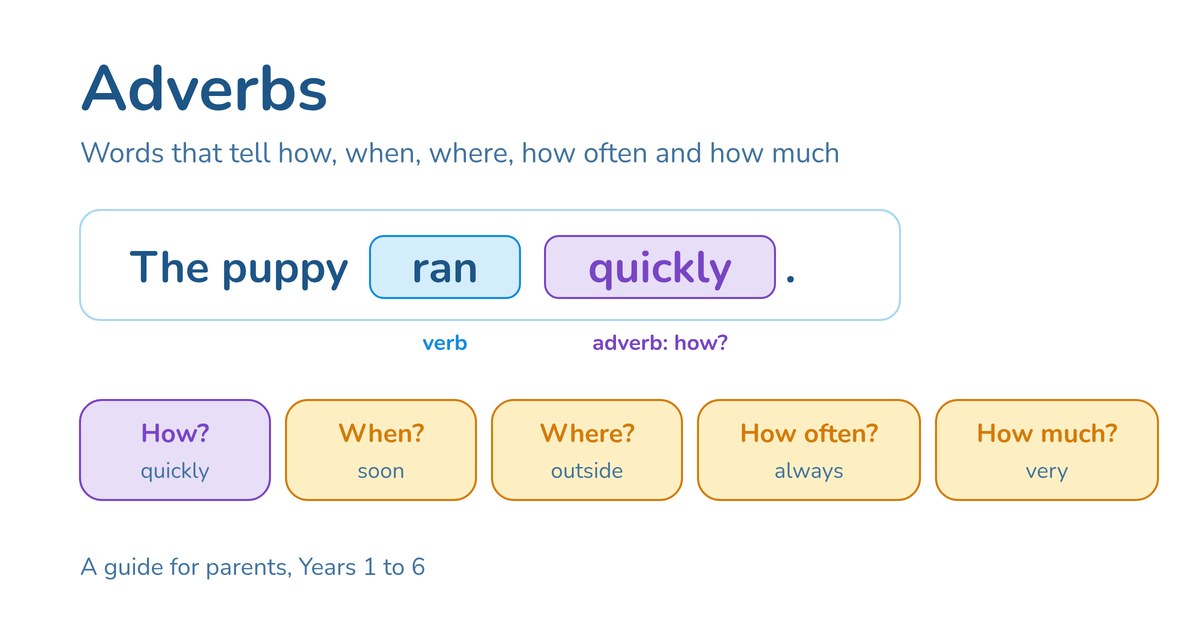
A Year 3 worksheet comes home saying "Circle the adverb in each sentence", and the first one is The puppy slept peacefully under the table. Your child circles puppy. You're fairly sure the answer is peacefully, but then the next sentence is We will go to the beach tomorrow, and you start to wonder whether tomorrow counts too. (It does.)
Adverbs are the words that tell us more about an action: how it happened, when, where, how often, or how much. They're small, but they do a lot of work in both reading and writing. A story where "the dog barked" is very different from one where "the dog barked furiously all night". Learning to notice and use adverbs helps children picture scenes more clearly when they read, and add precise detail when they write.
This guide explains what adverbs are, the main kinds with plenty of examples, the famous -ly clue and where it goes wrong, how adverbs differ from adjectives, what teachers mean by "adverb groups" and "adverbials", where adverbs can sit in a sentence, how the Australian Curriculum builds the idea from Year 1, the mix-ups to expect, and some quick games to play at home.
What is an adverb?
An adverb is a word that adds detail to a verb, an adjective or another adverb. Most of the time, children meet adverbs describing verbs (doing or being words):
- The kookaburra laughed loudly. (How did it laugh?)
- We arrived early. (When did we arrive?)
- The cat is hiding upstairs. (Where is it hiding?)
A handy test is to find the verb and ask how?, when?, where?, how often? or how much? about it. If a word answers one of those questions, it's probably working as an adverb.
If your child isn't yet sure what a verb is, start there. The guide to nouns, verbs and adjectives covers the building blocks, and adverbs make much more sense once verbs are secure.
The five jobs adverbs do
Teachers often group adverbs by the question they answer. You don't need to memorise the labels, but sorting them this way helps children spot them.
| Question | Type | Examples |
|---|---|---|
| How? | manner | quickly, carefully, gently, badly, well |
| When? | time | now, yesterday, soon, later, already |
| Where? | place | here, outside, everywhere, nearby, away |
| How often? | frequency | always, never, often, sometimes, rarely |
| How much? | degree | very, quite, almost, too, extremely |
The manner adverbs are the ones children usually learn first, because they're easy to act out. Ask your child to walk across the room slowly, then quickly, then sneakily, and they'll feel the difference straight away.
Degree adverbs are a little different. They usually sit in front of an adjective or another adverb to turn the volume up or down: very cold, quite tired, too loud, almost finished, really quickly.
The -ly clue (and when it lets you down)
Lots of manner adverbs are made by adding -ly to an adjective:
- slow → slowly
- quiet → quietly
- brave → bravely
- careful → carefully
That's a useful clue, and it links neatly to the work on prefixes and suffixes. There are a few spelling patterns to know when adding -ly:
- y becomes i: happy → happily, easy → easily, angry → angrily
- -le becomes -ly: gentle → gently, simple → simply, terrible → terribly
- words ending in l keep both l's: careful → carefully, real → really, usual → usually
Older children working on spelling and morphology practise these rules as part of learning how words are built.
The trouble is that -ly isn't a perfect test. Two traps catch children out:
Not every -ly word is an adverb. Friendly, lovely, lonely, silly, ugly and curly are adjectives. They describe nouns: a friendly dog, a lonely road, curly hair. You can't say "she smiled friendly"; you'd say "she smiled in a friendly way".
Plenty of adverbs don't end in -ly. Fast, hard, well, soon, never, often, here, very and tomorrow are all adverbs, and none of them has the ending. Some words, like fast and hard, can be either an adjective or an adverb depending on the sentence: a fast car (adjective), the car went fast (adverb).
So the best test is always the question one: what is this word telling us more about?
Adverb or adjective?
This is the mix-up teachers see most. The difference lies in what the word describes.
- Adjectives describe nouns. The quiet girl (which girl? the quiet one).
- Adverbs describe verbs, adjectives or other adverbs. The girl spoke quietly (how did she speak? quietly).
Pairs like these make the idea clear:
- a careful driver / drives carefully
- a loud bang / banged loudly
- a good singer / sings well
That last pair is worth a moment. Good is the adjective; well is its adverb partner. "You did good" is common in casual speech, but in school writing children are expected to write "You did well". Gentle modelling in conversation ("Yes, you played really well!") helps more than correcting every slip.
Adverb groups, phrases and adverbials
From about Year 4, the vocabulary on worksheets gets more technical. Teachers start talking about adverb groups (or adverb phrases) and prepositional phrases, and sometimes about adverbials or circumstances. These sound intimidating, but they're a simple step up.
An adverb group is two or more words built around an adverb: very slowly, quite often, almost immediately, much later.
A prepositional phrase starts with a preposition (a word like in, on, under, after, during or with) and does the same job as an adverb, giving detail about when, where or how: after lunch, under the bridge, with a big grin, during the storm.
Put together, these tell the reader the circumstances of an action. Here's an example in the style teachers often use:
At dawn, the old fisherman rowed silently across the bay.
- At dawn tells us when
- silently tells us how
- across the bay tells us where
Some worksheets, especially ones from overseas, call a phrase like At dawn at the start of a sentence a "fronted adverbial". Australian classrooms are more likely to just say "an adverbial at the start of the sentence". Either way, it's usually followed by a comma, which links to the punctuation guide.
Where adverbs can go in a sentence
One of the nice things about adverbs is that many of them can move. Look at these:
- Suddenly, the lights went out.
- The lights suddenly went out.
- The lights went out suddenly.
All three are correct, but they feel slightly different. Starting with Suddenly creates a jolt, which is why it shows up so often in exciting moments. Writers use this to build suspense and to vary how their sentences begin.
Frequency adverbs like always, usually and never have a favourite spot: just before the main verb (She always forgets her hat) or after is, am or are (He is never late).
And one tiny adverb can change the whole meaning depending on where it goes. Compare:
- Only Sam ate the cake. (Nobody else ate it.)
- Sam ate only the cake. (He didn't eat anything else.)
Older children enjoy this kind of puzzle, and it's a good way to show that word order matters.
How adverbs help with reading
Adverbs are part of what turns words on a page into a picture in your child's head. When a character "crept nervously down the hallway", the adverb tells us both how they moved and how they felt. Pausing on those words supports visualising while reading, and it's a natural lead-in to talking about character traits: what does it tell us about someone if they always share, or never say sorry?
Adverbs also carry a lot of an author's tone. "She answered sweetly" and "she answered coldly" describe the same action with completely different attitudes. In dialogue, adverbs after said (said angrily, whispered softly) are one of the main ways writers show how a line should sound.
Time adverbs such as first, then, later and finally help readers follow the order of events, which supports work on sequence.
How adverbs help with writing
In early writing, adverbs are a quick way to add detail. The dog ran becomes The dog ran quickly, and then, with a little prompting, Yesterday the dog ran quickly across the park. That's a big jump in information for three extra words.
As children get older, teachers nudge them a step further. Sometimes a stronger verb does the job better than a verb plus adverb:
- ran quickly → raced, sprinted, dashed
- said quietly → whispered, murmured
- ate hungrily → gobbled, devoured
Neither approach is wrong. The aim is for children to choose, rather than reaching for very or really in every sentence. If your child's writing is full of "very very big" and "really really scary", a short chat about synonyms (huge, terrifying) can lift it quickly. Building a richer word bank through vocabulary while reading helps too.
Adverbs also help children write longer, more varied sentences, which connects to work on simple, compound and complex sentences.
Comparing with adverbs
Just like adjectives, many adverbs can compare:
- Short adverbs add -er and -est: fast, faster, fastest; hard, harder, hardest; soon, sooner, soonest.
- Longer adverbs use more and most: carefully, more carefully, most carefully.
- A few are irregular: well, better, best; badly, worse, worst.
"Who can run the fastest?" and "Try to write more neatly" are everyday examples your child already hears.
Adverbs in the Australian Curriculum
The current (v9) English curriculum brings in adverbs early and returns to them several times:
- Year 1: children learn that some words give details such as when, where and how, and that these are called adverbs, alongside nouns, verbs and adjectives.
- Year 2: the focus is on noun groups and verb groups, and children begin to choose words more deliberately to suit what they're writing. See Year 2 reading.
- Year 3: children look at how verbs and tense work, and adverbs keep appearing as they describe actions in more detail. Year 3 reading has the wider picture.
- Year 4: students explore how adverb groups and prepositional phrases give circumstantial details about an activity, such as time, place and manner. This is where "adverbials" usually appear. See Year 4 reading.
- Years 5 and 6: writers learn to sharpen their ideas through careful choices of verbs, tenses and a range of adverb groups. Year 5 reading and Year 6 reading explain more.
Adverbs also sit alongside pronouns and verb tenses in the grammar children practise through primary school.
Mix-ups you're likely to see
Circling every -ly word. Friendly, lovely and lonely get marked as adverbs. Ask: "Is it describing a thing or an action?"
Missing the adverbs without -ly. Tomorrow, outside and never slip past unnoticed. Go back to the five questions: how, when, where, how often, how much.
Spelling the ending. "Happyly", "gentlely" and "carefuly" are all common. Point out the three spelling patterns above, one at a time.
Using an adjective where an adverb belongs. "She runs quick" or "He did good". Model the correct version naturally rather than stopping the conversation.
Overusing very and really. Especially in Years 2 to 4. Encourage one stronger word instead of two weak ones.
Forgetting the comma. After school we went to the pool is often fine, but a longer opener reads better with a comma: After a long, hot day at school, we went to the pool.
Games to play at home
Adverbs are perfect for silly, active games:
- Adverb charades. Write adverbs on slips of paper (grumpily, sleepily, proudly, nervously). One person acts out an ordinary task, like brushing teeth, in the manner of the adverb while the others guess.
- Sentence stretch. Start with a tiny sentence, such as The cat slept. Take turns adding an adverb or phrase that answers a question: When? Where? How? See how long and vivid you can make it while it still makes sense.
- Bedtime hunt. While reading a picture book together, look for words that tell you how a character did something. Talk about how the page would feel without them.
- Always, sometimes, never. Make statements about your family ("Dad always burns the toast") and let your child agree or change the adverb.
- Swap it. Take a sentence with said plus an adverb and find a single verb that does the same job.
Five to ten minutes is plenty, and laughing along the way is part of the point.
When to look a bit closer
Grammar labels are learned slowly, and plenty of children can't name an adverb until Year 3 or 4. That's normal. If, by the middle primary years, your child shows any of the following, raise it with their teacher:
- struggles to say when, where or how something happened when retelling a story
- writes very short, bare sentences and finds it hard to add any detail, even with prompts
- has trouble following instructions that include words like before, after, slowly or carefully
- finds reading so effortful that there's no energy left to notice describing words
These can point to broader language or reading difficulties rather than a problem with adverbs in particular. For next steps, see checking whether your child is behind in reading, signs a reading concern needs attention and practical support for a struggling reader.
FAQ
What is an adverb in simple words?
An adverb is a word that tells you more about an action: how, when, where, how often or how much it happens. In She sang beautifully, the adverb beautifully tells you how she sang.
Do all adverbs end in -ly?
No. Many do, like quickly and softly, but lots don't, such as fast, well, soon, never, here and tomorrow. And some -ly words, like friendly and lovely, are adjectives.
What is a fronted adverbial?
It's a word or phrase that tells you when, where or how, placed at the start of a sentence, like Later that night, or Without a sound,. It's usually followed by a comma. The term is more common in UK materials; Australian teachers may simply call it an adverbial or a sentence opener.
What's the difference between an adverb and an adjective?
Adjectives describe nouns (a slow snail). Adverbs describe verbs, adjectives or other adverbs (the snail moved slowly). Asking "is it describing a thing or an action?" usually sorts it out.
Try this tonight
Pick one ordinary sentence about your child's day, like I ate my lunch. Ask them to say it three different ways by adding an adverb each time: I ate my lunch quickly, I ate my lunch outside, I always eat my lunch. Then ask which version tells you the most, and which sounds the funniest.
If you'd like a broader look at how your child is going with reading, the free check from Ziado is a short online activity of about ten minutes, done at home on a tablet or computer. The questions respond to each answer, stepping up or easing back so your child isn't stuck on things far too hard or too easy. A first snapshot of results appears straight away; no account or card is needed, and the full placement unlocks once you sign up. Grammar labels like adverb aren't tested, it has nothing to do with NAPLAN, and it can't diagnose a reading difficulty. To see how everyday practice is set up, visit Ziado reading; the Individual and Family plans both start with a free 14-day trial, and current details are on the pricing page.
Wondering how your child's grammar and reading are tracking?
Ziado's free check is a one-off, roughly 10-minute adaptive diagnostic with partial results only - no account, no card. The full placement unlocks after signup.
Start the free reading check