Prepositions explained for parents (Australia)
Your Year 4 child brings home a grammar task: "Underline the prepositional phrase in each sentence." The first sentence is The lizard hid under a flat rock. Your child underlines lizard. You suspect the answer is under a flat rock, but then you hit She looked up and wonder whether up counts. (In that sentence, it's actually working as an adverb, which we'll get to.)
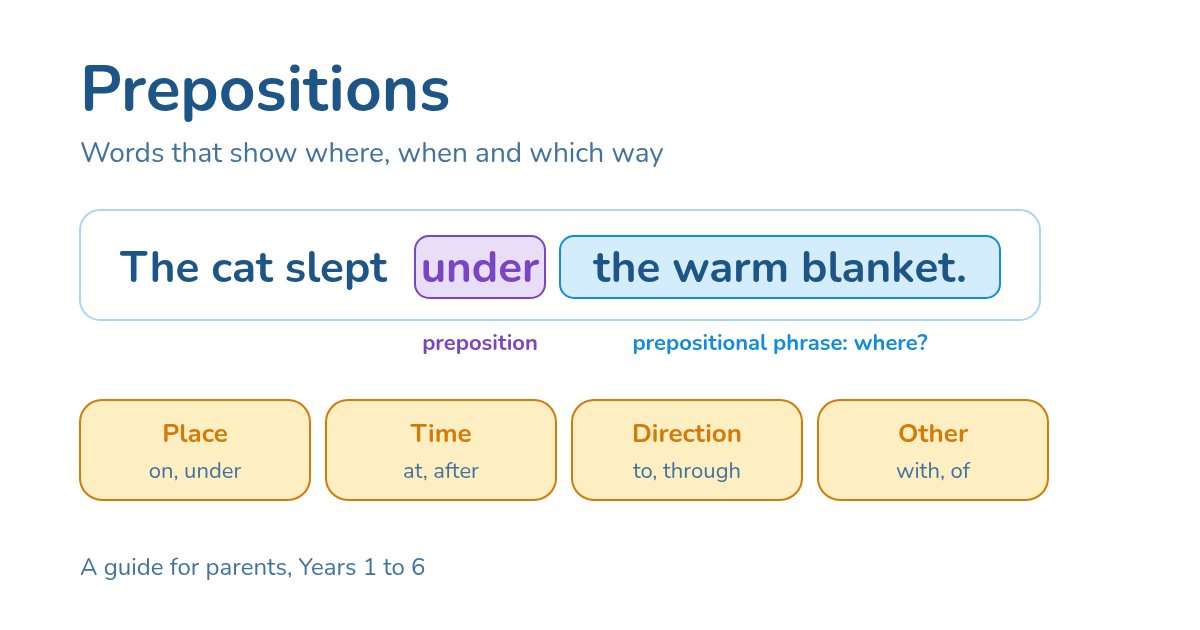
Prepositions are small, ordinary words like in, on, under, after and with. They link a noun or pronoun to the rest of the sentence and show how things relate: where something is, when something happened, which way something moved, or who it was with. Children use them from toddlerhood ("Teddy in bed!"), so the words aren't new. What school adds is noticing them, naming them and using them on purpose to make writing clearer and richer.
This guide covers what prepositions are, the main groups with plenty of examples, what a prepositional phrase is, how to tell a preposition from an adverb or a joining word, the tricky time words at, on and in, commas after opening phrases, how prepositions help reading and writing, where they sit in the Australian Curriculum, the usual mix-ups and some games for home.
What is a preposition?
A preposition is a word that sits in front of a noun or pronoun and shows its relationship to something else in the sentence. The name gives a clue: it's "positioned before" the noun.
- The keys are on the bench.
- We'll go swimming after school.
- Mia walked with her grandad.
Take the preposition out and the sentence falls apart or loses meaning: "The keys are the bench" makes no sense. That's one handy test. Another is the "box test" many teachers use with younger children: anywhere you could put a toy in relation to a box (in, on, under, beside, behind, inside, over, near) is almost certainly a preposition.
The noun or pronoun that follows is called the object of the preposition. In on the bench, the object is bench.
The main groups of prepositions
Children don't need to memorise categories, but grouping prepositions by meaning makes them easier to notice.
Place: where something is
in, on, under, below, beneath, above, over, behind, in front of, beside, next to, between, among, near, inside, outside, opposite
The ball rolled behind the couch. The cat sleeps between the two pillows.
Direction or movement: which way something goes
to, into, onto, out of, towards, through, across, along, around, past, up, down, off, from
The kids raced across the oval. A possum climbed onto the roof.
Time: when something happens
at, on, in, before, after, during, since, until, by, from ... to
We have assembly on Friday. Nobody talks during the movie.
Other relationships
with, without, for, about, of, by, like, except, despite
A girl with curly hair. A book about sharks. She stayed calm despite the noise.
Notice that some prepositions are two or three words long, such as next to, in front of, out of and because of. They still do one job together.
What is a prepositional phrase?
A prepositional phrase is the preposition plus its object and any words that describe that object:
- under the table
- after a long, hot day
- beside the old wooden gate
The phrase can be short (at home) or long (through the dark tunnel under the railway line). A good classroom question is: "What's the whole chunk that starts with the preposition?" Children often underline just the preposition, or just the noun, when the task wants the whole phrase.
Prepositional phrases tend to do one of two jobs.
They add detail to the action. Many give the where, when or in-what-way of an event: At midnight, the dog barked at the gate. Teachers sometimes call these adverbial phrases, because they work the way adverbs do. The adverbs guide explains that side in more depth.
They add detail to a noun. Others tell you which one or what kind: the boy in the blue jumper, a jar of honey, the house on the corner. Here the phrase works like an adjective, helping to build a longer noun group. If your child is still sorting out nouns and adjectives, the nouns, verbs and adjectives guide is the place to start.
A single sentence can hold several prepositional phrases at once:
After breakfast, the girl with the red backpack walked to the bus stop on the corner.
That sentence has four: after breakfast (when), with the red backpack (which girl), to the bus stop (where she went) and on the corner (which bus stop).
Preposition or adverb?
This is the question that trips up most families, because many words can be either. The difference is whether an object follows.
- She looked up the chimney. Here up has an object (the chimney), so it's a preposition.
- She looked up. No object, so up is working as an adverb.
More pairs:
- The dog ran outside the yard (preposition) / The dog ran outside (adverb)
- We waited inside the car (preposition) / We waited inside (adverb)
- Come over the bridge (preposition) / Come over tomorrow (adverb)
The quick test: ask "____ what?" straight after the word. Up what? Up the chimney. If there's an answer in the sentence, it's a preposition.
Preposition or joining word?
Some words, such as before, after, since and until, can also act as conjunctions, joining two parts of a sentence. Again, look at what comes next.
- We ate after the game. A noun group follows, so after is a preposition.
- We ate after the game finished. A whole clause follows (the game finished has its own verb), so after is a conjunction.
Your child doesn't need to master this in primary school, but it explains why a worksheet answer can seem inconsistent. The simple, compound and complex sentences guide covers joining words and clauses.
At, on and in for time
These three cause more trouble than any other prepositions, especially for children learning English as an additional language. A simple pattern helps:
- at for an exact time or point: at 3 o'clock, at lunchtime, at night, at the weekend (common in Australia; on the weekend is used too)
- on for days and dates: on Monday, on 25 April, on my birthday
- in for longer stretches: in March, in winter, in 2026, in the morning
A memory picture: in is the big box (months, seasons, years), on is the medium box (days), and at is a pin pointing to an exact moment.
Prepositions and pronouns
After a preposition, pronouns take their object form: me, him, her, us, them. So it's with me, not with I, and for them, not for they.
Children (and many adults) get this right on its own but wrong in a pair. She gave it to my friend and I sounds polite but isn't correct. Take away my friend and and you'd never say She gave it to I, so it should be to my friend and me. The same test sorts out between you and me. The pronouns guide has more on this.
Commas after opening phrases
Writers often move a prepositional phrase to the start of a sentence for variety or emphasis:
- We played cricket in the backyard.
- In the backyard, we played cricket.
When the phrase comes first, a comma often follows it, especially if it's long. Short openers like At lunch we played cricket can go without one. Year 5 students learn to use commas to mark off prepositional phrases. The punctuation guide explains commas more broadly.
Ending a sentence with a preposition
You may have been taught never to end a sentence with a preposition. Modern grammar guides don't treat this as a rule. Who did you go with? is natural English, and With whom did you go? sounds stiff. Teachers generally care far more about clear meaning than this old rule, so there's no need to correct your child for it.
How prepositions help with reading
Prepositions carry a surprising amount of meaning in a text, and children who skim over them can lose track of what's happening.
- Picturing the scene. In The fox crept along the fence and slipped under the gate, the prepositions do most of the work of showing the movement. Asking your child to sketch or act out a sentence like that is a great check. See visualising while reading for more on making mental pictures.
- Following the setting. Descriptions of place lean heavily on prepositions: on the edge of the desert, beneath the gum trees, across the river from town. The setting guide shows how authors build a sense of place.
- Keeping events in order. Time phrases such as before dawn, after the storm and during the night help readers track when things happen, which links to the sequence guide.
- Reading instructions. Recipes, science experiments and maps depend on exact prepositions. Pour the milk into the bowl and pour the milk onto the bowl lead to very different mess.
If your child often misreads small words, it can be worth noticing whether they're dropping or swapping prepositions as they read aloud. Children who guess words while reading sometimes swap on for in or skip of entirely.
How prepositions help with writing
In writing, prepositional phrases are one of the easiest ways for children to add detail without piling up adjectives.
Compare:
- The dog barked.
- The dog barked at the postman from behind the fence.
The second sentence answers questions a reader might have: at whom? from where? Teachers often call this "stretching a sentence". A simple prompt at home is to ask where?, when? or with whom? after a short sentence, and add a phrase to answer.
Varying where the phrase goes also helps. A story where every sentence starts with The or I feels flat; starting some with Under the bridge, After a while or Without a word makes writing flow better. Older students learn to choose precise prepositions too: through the forest feels different from around the forest or into the forest.
Prepositions in the Australian Curriculum
The national English curriculum (version 9) places prepositions in its Language strand, and the skill builds bit by bit:
- Foundation to Year 2: children build oral vocabulary for position, direction and time, and begin to expand simple sentences with detail. Position words also turn up in maths, through position and location.
- Year 4: students learn how adverb groups and prepositional phrases provide extra details about an activity, such as when, where and how it happened.
- Year 5: they expand noun groups in a range of ways to give fuller descriptions (the old wooden door with a rusty handle), and they use commas to mark off prepositional phrases.
- Year 6 and beyond: they choose phrases deliberately for effect and precision in their own writing.
Schools vary in pace and terms. Our year-level overviews give the broader picture: Year 2 skills, Year 3 skills, Year 4 skills, Year 5 skills and Year 6 skills.
Mix-ups you're likely to see
Underlining only the preposition. When asked for the phrase, underline the whole chunk from the preposition to the end of its noun group.
Calling every position word a preposition. Up, down, inside and outside are only prepositions when an object follows. Use the "____ what?" test.
In or into, on or onto. In and on describe where something is; into and onto describe movement to a place. He jumped in the pool (already there, splashing about) can differ from He jumped into the pool (from the edge). Everyday speech blurs these, so a gentle reminder in writing is enough.
Between or among. Between is traditionally used for two (or for clearly separate items), among for a group: between the two trees, among the crowd.
Off of. He fell off of his bike is common in speech, but in writing off is enough: He fell off his bike.
Could of, should of. These aren't prepositions at all. They're mishearings of could've and should've. The contractions guide explains the fix.
Phrasal verbs. In give up, look after and run out of, the little word changes the meaning of the verb. These can confuse children learning English, because the meaning isn't the sum of the parts. The idioms guide covers similar puzzles.
Games to play at home
Prepositions are perfect for quick, physical games, especially with younger children.
- Where's the teddy? Hide a soft toy and give clues using only prepositions: It's under something soft, beside something tall. Then swap roles.
- Simon says (position version). Simon says put your hand on your head. Simon says stand behind the chair.
- Barrier game. Sit back to back. One person builds or draws something simple and describes it (the red block goes on top of the blue one); the other has to copy it without looking.
- Treasure map. Draw a map of the backyard or a park together and write directions: walk past the clothesline, through the gate, and stop beside the lemon tree.
- Sentence stretch. Say a short sentence like The bird sang. Take turns adding a prepositional phrase each: The bird sang in the tree. The bird sang in the tree at dawn. The bird with yellow feathers sang in the tree at dawn.
For the wider picture of word knowledge, the vocabulary while reading guide has more everyday ideas.
When to look a bit closer
Most children pick up prepositions naturally through talk and reading. It may be worth checking in with the teacher if your child:
- by the start of school, often can't follow simple position instructions like put it under the chair
- regularly mixes up before and after or in front of and behind well into Year 1 or 2
- often loses track of what's happening when reading stories with lots of movement or time changes
- is learning English and finds these words especially confusing (very normal, and well worth support)
Persistent trouble with understanding instructions can be part of a broader language difficulty, and a speech pathologist can assess this. If you're weighing up next steps, read our pages on whether a child is behind with reading, reading red flags and supporting a reader who's finding it hard.
FAQ
What is a preposition in simple words?
It's a small word that links a noun or pronoun to the rest of the sentence and shows how they're related, often in place or time. In, on, under, after, with and between are common examples.
What is a prepositional phrase?
It's a group of words that starts with a preposition and ends with its object, plus any describing words in between. Under the old bridge and after lunch are both prepositional phrases.
How can you tell a preposition from an adverb?
Check whether a noun or pronoun follows. In She climbed up the ladder, up is a preposition because the ladder follows. In She climbed up, nothing follows, so up is an adverb.
Is it wrong to end a sentence with a preposition?
No. Most modern grammar guides accept it, and sentences like What are you looking at? are natural English. Teachers are far more interested in whether the sentence is clear.
Try this tonight
While you're making dinner, give your child three quick instructions that use prepositions: Put the spoon beside the bowl, the cup behind the plate, and the napkin under the fork. Then let them give you three. It takes a minute, it's oddly satisfying, and it turns grammar into something you can see on the table.
For a wider view of your child's reading skills, Ziado offers a free check: roughly ten minutes online, done at home on a laptop or tablet. Each answer shapes the next question, so it settles at a level that suits your child rather than sticking to a fixed list. Some first results come up as soon as it finishes, you won't need to set up an account or hand over card details, and the full placement is ready after you register. It doesn't quiz grammar terms like preposition, it isn't a NAPLAN tool, and it can't diagnose a language or reading difficulty. You can see how regular practice is organised on the Ziado reading page; you get a fortnight free whichever plan you pick (Individual or Family), and what's on offer now is set out on the pricing page.
Wondering how your child's sentence skills are tracking?
Ziado's free check is a one-off, roughly 10-minute adaptive diagnostic with partial results only - no account, no card. The full placement unlocks after signup.
Start the free reading check