Short and long vowels explained for parents (Australia)
Your Prep child sounds out c-a-t perfectly, then reaches the word cake in their reader and says "cack". Or your Year 1 child writes "bot" when they mean boat, and "hop" when the sentence is about hope. The teacher's note on the homework says "working on long vowels", and you're left wondering what makes a vowel long in the first place.
It isn't about how long you hold the sound. In phonics, "short" and "long" are simply the names for two families of vowel sounds. Short vowels are the quick sounds in cat, bed, pin, hot and cup. Long vowels are the sounds where the letter "says its name", as in cake, feet, kite, home and cube. Most early reading and spelling hinges on knowing which one a word needs.
Below you'll find what vowels are, the short and long sounds with example words, the clues that tell a reader which sound to use, the many spellings of each long vowel, how this affects spelling rules later on, where it sits in the Australian Curriculum, the mix-ups to expect, and simple games to play at home.
What makes a letter a vowel?
English has five main vowel letters: a, e, i, o and u. The letter y often does a vowel's job too, as in my, gym and happy. All the other letters are consonants.
Vowel sounds are made with an open mouth and nothing blocking the air. Ask your child to say "aaa" and then "mmm". For the first, the mouth stays open; for the second, the lips close. That's a quick, physical way to feel the difference.
Vowels matter because every syllable needs one. Cat has one vowel sound, rab-bit has two, el-e-phant has three. Clapping syllables and listening for the vowel sound in each beat is a useful early skill.
One thing that surprises parents is how few vowel letters there are compared with vowel sounds. Five letters (plus y) have to cover around twenty vowel sounds in Australian English, depending on accent and how linguists count them. That's why the same letter can sound different from word to word, and why phonics teaching spends so much time on vowels.
The five short vowel sounds
Short vowels are usually the first sounds children learn for each vowel letter, often with a picture cue:
| Letter | Short sound as in | More examples |
|---|---|---|
| a | apple | cat, map, sad |
| e | egg | bed, pen, wet |
| i | insect | pin, sit, big |
| o | octopus | hot, dog, top |
| u | umbrella | cup, bus, run |
These are the sounds in consonant-vowel-consonant words like sun and pig, which is why they come first. The guide to blending CVC words covers how children put them together into their first reads.
A note on accents: in many Australian voices, short e and short i sit close together, so pen and pin can sound almost alike. If your child mixes up those two when spelling, it may be their ears, not their effort. Exaggerating the mouth shape helps: short e has a slightly wider, lower jaw, short i a smile with teeth closer.
The five long vowel sounds
Long vowels are the sounds that match each letter's name:
| Letter | Long sound as in | More examples |
|---|---|---|
| a | cake | rain, play, baby |
| e | feet | me, beach, key |
| i | kite | my, light, tiger |
| o | home | go, boat, snow |
| u | cube | music, few, cute |
Long u is a slightly tricky one, because it often comes out as "oo" without the "y" sound at the front, as in flute, rule and blue. Many programs teach both versions together.
How does a reader know which sound to use?
This is what the teacher means by "working on long vowels". The letters around a vowel give strong hints, and children learn to look for them.
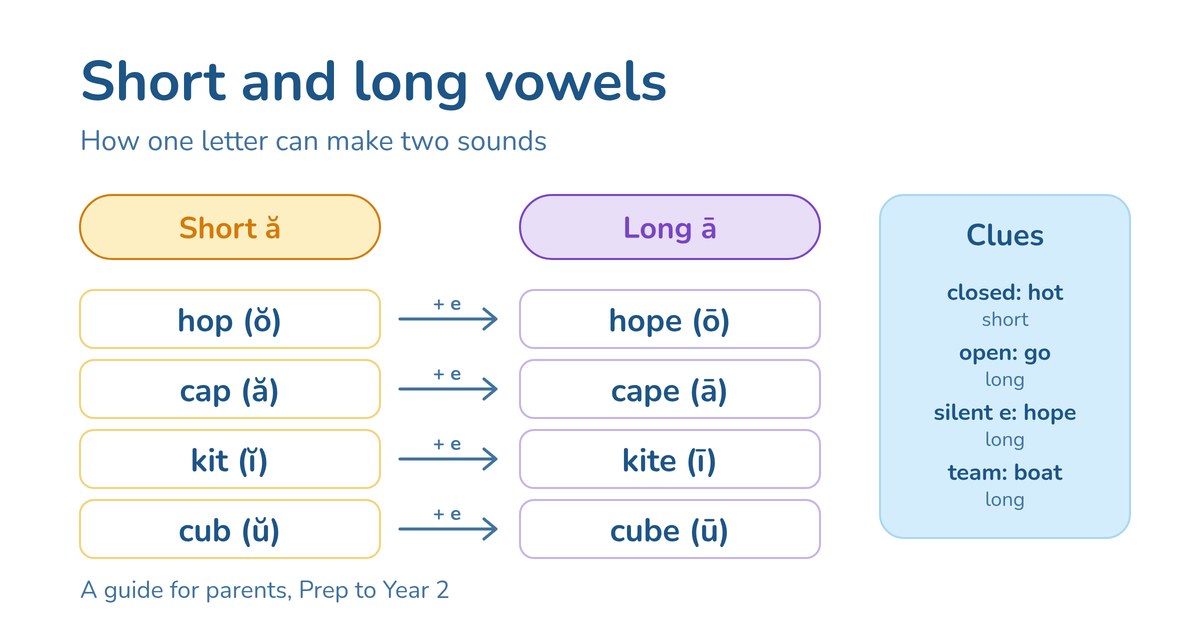
A vowel followed by a consonant is usually short. When a consonant "closes in" the vowel, as in hot, bed or the first part of rab-bit, the sound is short. Teachers call this a closed syllable.
A vowel at the end of a syllable is usually long. When nothing follows the vowel, as in go, me, hi or the first part of ti-ger and ba-by, the vowel tends to say its name. This is an open syllable.
A silent e at the end often makes the vowel long. Compare hop and hope, tap and tape, kit and kite, cub and cube. The e is silent but it changes the sound before it. The magic e guide goes through this pattern in detail, including the name "split digraph" that some schools use.
Two vowels side by side often make a long sound. In rain, feet, boat and pie, a pair of letters works together as one long vowel. These are called vowel teams, and the vowel teams guide lists the common ones.
These are patterns, not iron laws. Have, give and love end in e but keep a short vowel; great and head use the ea team for sounds other than long e. Many schools teach words like these as tricky or heart words until children learn the reasons.
A question that sometimes pops up: is beat a closed syllable? Not in the phonics sense. Although it ends with a t, the ea team gives a long e, so teachers usually call this a vowel-team syllable instead.
One long sound, many spellings
Here's where spelling gets harder than reading. A child who can read the long a in rain, play and cake still has to decide which spelling to write. These are the most common choices taught in the early years:
| Long sound | Common spellings | Examples |
|---|---|---|
| long a | a-e, ai, ay, a | cake, rain, day, apron |
| long e | ee, ea, e, y, ey | see, eat, he, happy, key |
| long i | i-e, igh, y, ie, i | bike, night, fly, tie, mind |
| long o | o-e, oa, ow, o | bone, coat, snow, no |
| long u | u-e, ew, ue, u | tune, new, glue, menu |
Position in the word is a big clue. Ay usually sits at the end of a word (day, stay), while ai sits in the middle (rain, paint). Igh tends to come before a t (night, light). Children who learn these "where it goes" patterns make far fewer spelling slips.
Phonics programs introduce these spellings gradually, over Year 1 and Year 2, rather than all at once. The general guide to phonics for parents explains the typical order.
Other vowel sounds that are neither short nor long
Vowels have a few more tricks, and it helps to know they exist:
- Two "oo" sounds. Book and look use a short oo; moon and food use a long one.
- Vowels with r. In car, her, bird, fork and turn, the r changes the vowel into something new. The r-controlled vowels guide covers this group.
- Sliding sounds. Oi/oy (coin, boy) and ou/ow (out, cow) glide from one mouth shape to another.
- The schwa. In longer words, an unstressed vowel often shrinks to a lazy "uh". The first a in about, the o in lemon and the a at the end of banana all make it. It's the most common vowel sound in English, and the reason children write "lemin" or "afta".
Why it matters for spelling later on
Short and long vowels drive several spelling rules children meet in Years 2 to 4, especially when adding endings.
Doubling to keep a vowel short. Hop becomes hopping (double p), while hope becomes hoping (drop the e). The double consonant protects the short vowel. The same pair shows up in tapped and taped, dinner and diner, filling and filing. If your child writes "hoping" when they mean they're jumping on one foot, this is the rule to look at.
Ck after a short vowel. Back, neck, pick, sock and duck use ck, while bake, bike and soak (long vowels) don't.
Tch and dge. Catch, fetch and badge follow a short vowel. Coach and page have a long vowel, so the plain ch or ge is enough.
These patterns make up a big part of the word work in spelling and morphology, and they connect to adding suffixes and plurals.
Those little marks on worksheets
Some worksheets mark vowels with symbols:
- A curved "smile" above the letter (ă) marks a short vowel. It's called a breve.
- A straight line above the letter (ā) marks a long vowel. It's called a macron.
Not every school uses them, and your child doesn't need to know the names. If they appear, they're just a reminder of which sound to say.
Vowels in the curriculum, year by year
Version 9 of the national English curriculum builds vowel knowledge step by step:
- Foundation (Prep): children learn the most common sound for each letter, which for vowels is the short sound, and read and write CVC words. See what Prep reading covers.
- Year 1: children use short vowels, common long vowels, digraphs and blends to read and write one- and two-syllable words. They also learn that one letter can stand for more than one sound and that every syllable needs a vowel sound. The Year 1 phonics check includes real and made-up words that test exactly these skills.
- Year 2: children work with a wider range of vowel spellings and longer words. Year 2 reading has the fuller picture.
- Year 3 and beyond: the focus moves to spelling rules for adding endings, the schwa in longer words, and word meaning.
The reading milestones from Prep to Year 2 guide gives a broader sense of what's typical.
Mix-ups you're likely to see
Reading the letter name instead of the sound. A child sees a and says "ay" in cat, giving "cayt". Early on, practise the short sound as the "first job" of each vowel.
Ignoring the silent e. Cape is read as cap, pine as pin. A gentle prompt: "Look at the end of the word. Is there an e?"
Missing letters in vowel teams. "Bot" for boat or "ran" for rain. The child hears a long vowel but writes a single letter. Ask them to check the long-sound spelling list together.
Short e and short i swaps. "Pin" for pen, "bid" for bed. Check whether your child can hear the difference before treating it as a spelling problem.
Guessing from the first letter. If a child sees bike and says "bake" or "book", they may be relying on the first letter and the picture rather than working through the word. The guide on children who guess words has more on this habit.
Games to play at home
Short, playful practice works best:
- Short or long sort. Write words on cards (hat, hate, kit, kite, cod, code, tub, tube). Sort them into two piles, then read the pairs side by side.
- Add an e. Write pin on a whiteboard, then add an e. Ask what changed. Try cap, rob, cut, not and hid.
- Change the middle. Build cat with letter tiles, then swap only the vowel: cot, cut, kit. This is great for tuning the ear to short sounds, and it ties in with segmenting words into sounds.
- Mirror mouths. Say each short vowel in front of a mirror and notice how the mouth changes.
- Long vowel hunt. While reading a decodable reader, find every word with a long a sound and see how many spellings turn up.
Keep it to five or ten minutes. Stopping while it's still fun is the goal.
When to talk to the teacher
Every child mixes up vowels sometimes, and Year 1 is when it usually settles. It's a good idea to raise it with the teacher if, around the end of Year 1 or into Year 2, your child:
- still can't reliably say the short sound for each vowel letter
- can't hear the difference between pairs like hop and hope when you say them
- leaves vowels out of words when writing (bd for bed)
- reads quite slowly and avoids books because sounding out is so hard
These can point to gaps in early sound skills, which respond well to targeted practice. For next steps, look at whether your child might be behind in reading, reading warning signs worth acting on, and ways to help a struggling reader.
FAQ
How many vowels are there in English?
There are five vowel letters (a, e, i, o, u), with y often acting as a vowel. There are many more vowel sounds, around twenty in Australian English, which is why each letter can be read in more than one way.
What does "the vowel says its name" mean?
It means the vowel makes the same sound as its letter name, as in cake (a), me (e), kite (i), go (o) and cube (u). Those are the long vowel sounds.
Which should my child learn first, short or long vowels?
Short vowels usually come first, in Prep, because they appear in simple three-letter words. Long vowels and their spellings follow mostly in Year 1 and Year 2.
Why does my child spell "boat" as "bot"?
They've heard the long o but haven't yet learned that it's often spelled oa or ow. This is a normal stage; practising the common spellings of each long vowel usually sorts it out.
A quick game before bed
Say pairs of words aloud, one at a time: cap / cape, kit / kite, rob / robe. After each pair, your child gives a thumbs up for a long vowel and a thumbs down for a short one. Then let them say a pair for you to judge.
To find out more about your child's reading as a whole, try the Ziado free check. It's an online task of about ten minutes that your child can complete at home, and it adapts to their answers by moving up or down in difficulty. Some initial results appear as soon as it's finished, without creating an account or handing over card details, and the whole placement is available once you sign up. It won't give a separate vowel score, isn't NAPLAN preparation, and isn't a dyslexia screen or a diagnosis of anything. Daily practice is shown on Ziado reading, and both plans (Individual or Family) start with 14 days free; check pricing for what's offered right now.
Keen to see the whole picture of your child's reading?
Ziado's free check is a one-off, roughly 10-minute adaptive diagnostic with partial results only - no account, no card. The full placement unlocks after signup.
Start the free reading check