Prime factorisation explained for parents (Australia)
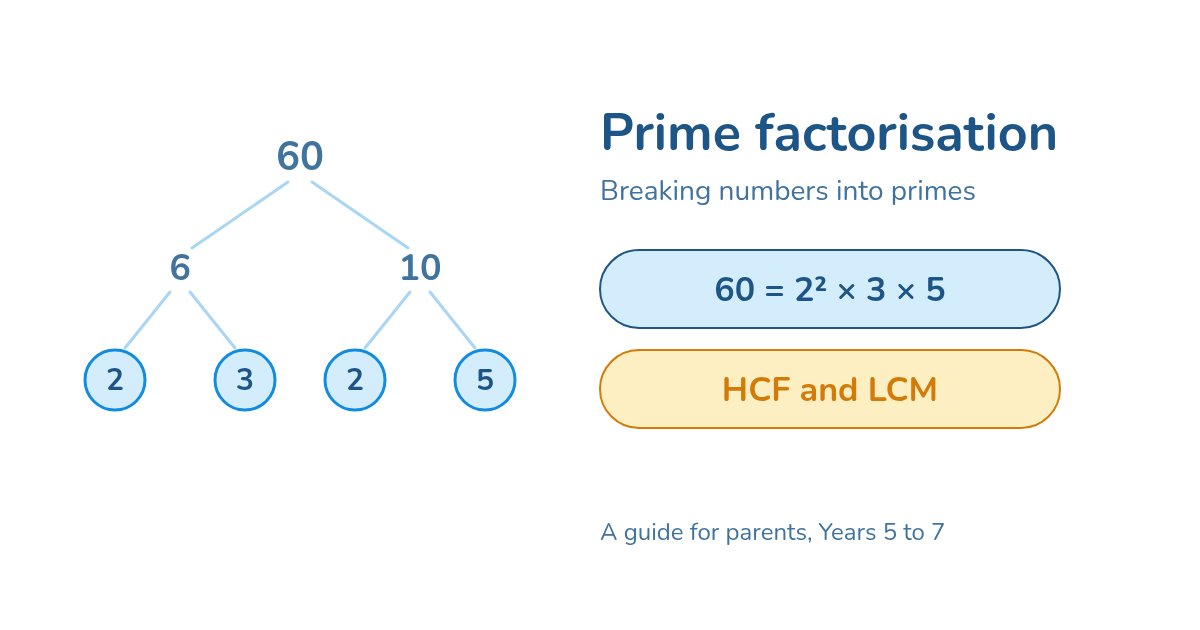
Your Year 7 child's worksheet is covered in upside-down trees. The first says "Write 60 as a product of prime factors using index notation." Your child has written 6 × 10 and stopped. The answer key wants 2² × 3 × 5, and you're not sure how to get there, or what that little raised 2 means.
The idea underneath is friendlier than the jargon. Every whole number bigger than 1 is either a prime or can be built by multiplying primes, a bit like a Lego model made from a few basic bricks. Finding those bricks is prime factorisation, and it makes simplifying fractions, common denominators and "when will these line up?" problems much easier.
Below: what the words mean, the two school methods (factor trees and the division ladder), the small raised numbers, using the result for highest common factor and lowest common multiple, the curriculum outline, frequent slip-ups and home practice.
The building blocks your child needs first
Three earlier ideas carry this topic; when it feels hard, one of them is usually the gap.
- Factors. A factor divides a number exactly. For example, 12 has six factors: 1, 2, 3, 4, 6 and 12. Start with the factors and multiples guide if this is shaky.
- Primes. A prime can only be divided evenly by 1 and by itself: 2, 3, 5, 7, 11, 13 and so on. 1 is not prime, since it has only one factor. The prime numbers guide explains more.
- Quick multiplication facts. Most of the work is spotting what divides evenly, so solid times tables make it fast and finger-counting makes it exhausting.
Quick tests for 2, 3 and 5 save time too: even numbers divide by 2, a digit sum in the 3 times table means it divides by 3, and a last digit of 0 or 5 means it divides by 5. The divisibility rules guide has the rest.
What "prime factorisation" actually means
Break the phrase into its parts:
- Factorisation means writing a number as a multiplication. 60 = 6 × 10 is one factorisation; so is 60 = 4 × 15.
- Prime means every number in that multiplication has to be a prime.
So the prime factorisation of 60 is 2 × 2 × 3 × 5. Multiply those four primes and you get 60, and none of them can be split any further.
The reassuring part is that every number has exactly one prime factorisation. Start 60 as 6 × 10, 4 × 15 or 2 × 30 and you still finish with two 2s, one 3 and one 5; only the order changes. (Mathematicians call this the fundamental theorem of arithmetic, though your child doesn't need the name.)
This is also why 1 isn't counted as a prime. If it were, you could tack as many 1s as you liked onto any factorisation and the answer would stop being unique.
Method 1: the factor tree
Most classrooms start here, because children can see the number breaking apart.
- Write the number at the top.
- Split it into any two factors (other than 1 and itself) and draw a branch to each.
- Circle any branch that ends in a prime. That branch is finished.
- Keep splitting any branch that isn't prime.
- When every branch ends in a circled prime, collect the circled numbers and write them as a multiplication.
Here is 60, starting with 6 × 10:
- 60 splits into 6 and 10
- 6 splits into 2 and 3, both prime, so circle them
- 10 splits into 2 and 5, both prime, so circle them
- The circled primes are 2, 3, 2 and 5, so 60 = 2 × 2 × 3 × 5
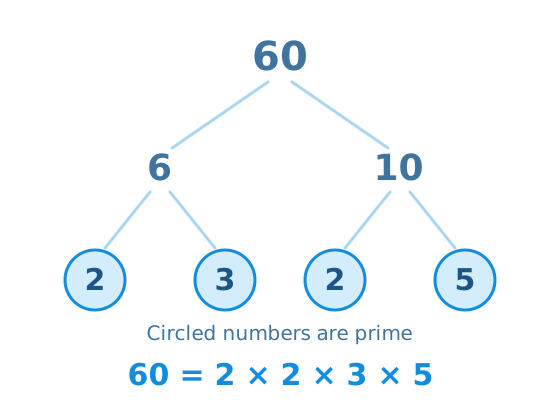
Start instead with 4 × 15 and the tree looks different, but the circled primes are the same four. Doing one number two ways side by side convinces sceptical children.
A second example, 72:
- 72 splits into 8 and 9
- 8 splits into 2 and 4, and 4 splits into 2 and 2
- 9 splits into 3 and 3
- So 72 = 2 × 2 × 2 × 3 × 3
Tip: take any split that works. Even? Take out a 2. Ends in 0? Split off a 10. Hunting for the perfect first split is how children stall.
Method 2: the division ladder
Some teachers prefer repeated division, often called the ladder: keep dividing by the smallest prime that works.
For 360:
- 360 ÷ 2 = 180
- 180 ÷ 2 = 90
- 90 ÷ 2 = 45
- 45 isn't even, so try 3: 45 ÷ 3 = 15
- 15 ÷ 3 = 5
- 5 ÷ 5 = 1, so stop
The primes you divided by are the answer: 360 = 2 × 2 × 2 × 3 × 3 × 5.
The ladder suits children who like a fixed routine: try 2, then 3, then 5, then 7, moving up only when the current prime stops dividing. Many classes write it in the "bus stop" shape from long division.
A useful fact for checking: if no prime up to the square root of a number divides it, the number itself is prime. For 97, the square root is a little under 10, so testing 2, 3, 5 and 7 is enough. None of them divides it, so 97 is prime and its tree has no branches at all.
Index notation: the little raised numbers
Year 7 classes write repeated primes in a shorter form called index (or exponent) notation. The small raised number, the index, says how many copies of the prime are multiplied.
- 2 × 2 = 2² (read "2 squared" or "2 to the power of 2"), which is 4
- 2 × 2 × 2 = 2³ ("2 cubed"), which is 8
- 3 × 3 × 3 × 3 = 3⁴ ("3 to the power of 4"), which is 81
So the answers above become:
- 60 = 2² × 3 × 5
- 72 = 2³ × 3²
- 360 = 2³ × 3² × 5
A frequent slip is reading 2³ as 2 × 3 = 6. It means three 2s multiplied, which is 8.
The curriculum also wants Year 7s to recognise powers of 2, 3 and 5, which turn up inside many trees:
- Powers of 2: 2, 4, 8, 16, 32, 64, 128, 256, 512
- Powers of 3: 3, 9, 27, 81, 243, 729
- Powers of 5: 5, 25, 125, 625
If your child has met square numbers and cube numbers, point out that "squared" and "cubed" here mean exactly the same thing. Index notation also has its own spot in the order of operations: powers are worked out before multiplying.
Why it's worth the effort
Finding the highest common factor (HCF)
The highest common factor of two numbers is the biggest number that divides both. To find it from the prime factorisations, take the primes the two numbers share, using the smaller power each time.
- 12 = 2² × 3
- 18 = 2 × 3²
- They share one 2 (the smaller power of 2 is 2¹) and one 3 (the smaller power of 3 is 3¹)
- HCF = 2 × 3 = 6
Another: 24 = 2³ × 3 and 36 = 2² × 3². The shared part is 2² × 3, so the HCF is 12.
Finding the lowest common multiple (LCM)
The lowest common multiple is the smallest number that both numbers divide into. This time take every prime that appears in either number, using the larger power.
- 12 = 2² × 3 and 18 = 2 × 3²
- The larger power of 2 is 2², and the larger power of 3 is 3²
- LCM = 2² × 3² = 4 × 9 = 36
For 24 and 36, the LCM is 2³ × 3² = 72.
A neat check: HCF × LCM always equals the two numbers multiplied. For 12 and 18, 6 × 36 = 216 = 12 × 18.
For small numbers, listing works: multiples of 4 go 4, 8, 12 and multiples of 6 go 6, 12, so the LCM is 12. Prime factorisation wins once listing would take ages; skip counting builds the listing habit.
Simplifying fractions in one step
Instead of halving 36/60 again and again, find the HCF directly: 36 = 2² × 3² and 60 = 2² × 3 × 5, so the HCF is 2² × 3 = 12. Dividing both by 12 gives 3/5 in one move. The simplifying fractions guide shows the slower step-by-step version too.
Lowest common denominators
When adding fractions with different denominators, the LCM of the denominators is the smallest shared denominator. For 5/12 + 7/18, the LCM of 12 and 18 is 36, so the sum becomes 15/36 + 14/36 = 29/36. See adding fractions and equivalent fractions for how renaming works.
Spotting squares and square roots
A number is a perfect square exactly when every index in its prime factorisation is even. 144 = 2⁴ × 3², and both 4 and 2 are even, so 144 is a square. Halve each index to find its square root: 2² × 3 = 12. In the same way, 216 = 2³ × 3³ is a perfect cube, and its cube root is 2 × 3 = 6.
Everyday problems that use it
- When will they line up again? (LCM) One bus leaves the stop every 12 minutes and another every 18 minutes. If both leave at 8:00 am, they next leave together 36 minutes later, at 8:36 am.
- Sausage sizzle maths (LCM). Sausages come in packs of 8 and bread rolls in bags of 6. To have the same number of each with none left over, you need 24 of each: 3 packs of sausages and 4 bags of rolls.
- Making identical bags (HCF). A teacher has 24 apples and 36 muesli bars and wants to make identical snack bags with nothing left over. The most bags possible is the HCF, 12, and each bag gets 2 apples and 3 muesli bars. A rough rule: "the biggest number that shares out evenly" usually means HCF, and "the first time they happen together" usually means LCM. The word problems guide has more on reading questions like these carefully.
Where it sits in the Australian Curriculum
In the national maths curriculum (version 9), the groundwork is laid over several years:
- Year 5: students write whole numbers as a product of factors, spot multiples and test whether one number divides exactly into another.
- Year 6: they sort numbers into prime, composite and square, describe what makes each type special, and use those features to make calculations simpler.
- Year 7: students represent natural numbers as products of powers of primes using index (exponent) notation. The curriculum suggests factor trees or repeated division, getting to know the powers of 2, 3 and 5, and using prime factorisations to solve problems with lowest common multiples and highest common factors.
So a Year 5 or 6 child doesn't need to write 2³ × 3² yet, though some enthusiastic classes have a go early. The Year 5 maths overview and the Year 6 maths overview set out everything else in those years.
Common slip-ups and how to fix them
Stopping too soon. Writing 60 = 6 × 10 and calling it done. Ask "Is every number at the end of a branch prime?" If any branch could split again, it isn't finished.
Leaving a composite number in the answer. Writing 24 = 2 × 3 × 4. The 4 is not prime, so it must become 2 × 2, giving 24 = 2³ × 3. Circling primes as soon as they appear helps children see which branches still need work.
Including 1. Writing 1 × 2 × 2 × 3 × 5. Remind them that 1 isn't prime, so it never appears in a prime factorisation.
Reading the index as a multiplier. Treating 2³ as 6 instead of 8. Get them to write the long version under the short one until it sticks.
Losing a prime when collecting. A child circles four primes but writes only three. Ticking each circled prime as it gets written down stops this. Then multiply the answer back out: if it doesn't give the starting number, something has gone missing.
Mixing up HCF and LCM. The HCF can never be bigger than the smaller number, and the LCM can never be smaller than the larger one. If your child says the HCF of 12 and 18 is 36, that check shows straight away that they've found the LCM instead.
Thinking odd means prime. 9, 15, 21 and 91 are odd but composite (91 = 7 × 13 fools adults too). See odd and even.
Practising at home
- Number plate trees. Take a two- or three-digit number from a car number plate or a letterbox and build its tree together on the back of an envelope. Who can find the most different first splits that still end with the same primes?
- Prime detective. Say a number and ask: prime or composite? If composite, what's the smallest prime that divides it? This rehearses the first step of the ladder.
- Guess my number. "I'm thinking of a number whose prime factorisation is 2 × 3 × 7. What is it?" (42.) Then let your child set one for you.
- Bus timetable puzzle. Make up two repeating events, like a dog that barks every 4 minutes and a bird that calls every 6, and ask when they'll happen together.
A few minutes two or three times a week is plenty. If evenings have become a fight, our tips on calmer homework sessions may help.
When to look a little closer
Factor trees usually click with practice. Have a word with the teacher if your child:
- can't reliably say whether small numbers like 15 or 21 divide by 3 or 5
- doesn't know their multiplication facts well enough to find a first split
- confuses factors with multiples even after lots of examples
- gets very anxious or shuts down when numbers get bigger
These usually trace back to multiplication fluency, which improves with calm, regular practice. Our guides on checking if your child is behind in maths and on maths warning signs can help you decide on next steps.
FAQ
What is prime factorisation in simple terms?
It's writing a number as a multiplication of prime numbers only. For example, 30 = 2 × 3 × 5. Every whole number above 1 has exactly one set of prime factors, so there's only one correct answer, although the primes can be written in any order.
What is a factor tree?
A factor tree is a diagram for finding prime factors. You split the number into two factors, then keep splitting until every branch ends in a prime. The primes at the ends of the branches make up the prime factorisation.
Why isn't 1 included in a prime factorisation?
Because 1 isn't a prime number. A prime has exactly two factors, and 1 has only one. Leaving it out also keeps each number's prime factorisation unique.
What year do Australian students learn prime factorisation?
Year 7, under version 9 of the Australian Curriculum. Primes and composite numbers come first in Year 6, and some Year 6 classes try simple factor trees.
Try this tonight
Ask your child to build a factor tree for your age or your house number, then start it a different way and check the same primes appear. Two minutes, and the worksheet becomes a puzzle.
If you'd like a clearer sense of where your child's number skills sit more broadly, try the free check from Ziado. It takes roughly ten minutes online and changes its questions as your child answers, moving up or easing off to find their level. A first look at the results appears straight after the last question (you don't sign up or pay to see it), and the fuller placement becomes available once you sign up. It doesn't test factor trees specifically, it isn't designed around NAPLAN, and it can't tell you whether a learning difficulty is present. For how ongoing practice works, the Ziado maths page explains it. Every plan, Individual or Family, starts with 14 days free, and the pricing page lists the latest options.
Curious how factors and primes are going for your child?
Ziado's free check is a one-off, roughly 10-minute adaptive diagnostic with partial results only - no account, no card. The full placement unlocks after signup.
Start the free maths check