Square roots explained for parents (Australia)
Your Year 6 or Year 7 child brings home a sheet covered in the √ symbol. One question says "Find √81." Another says "Estimate √50." Your child remembers that 9 × 9 = 81, so √81 is 9, but √50 feels like a guess. You're not sure whether the answer should be a whole number, a decimal, or left under the radical sign.
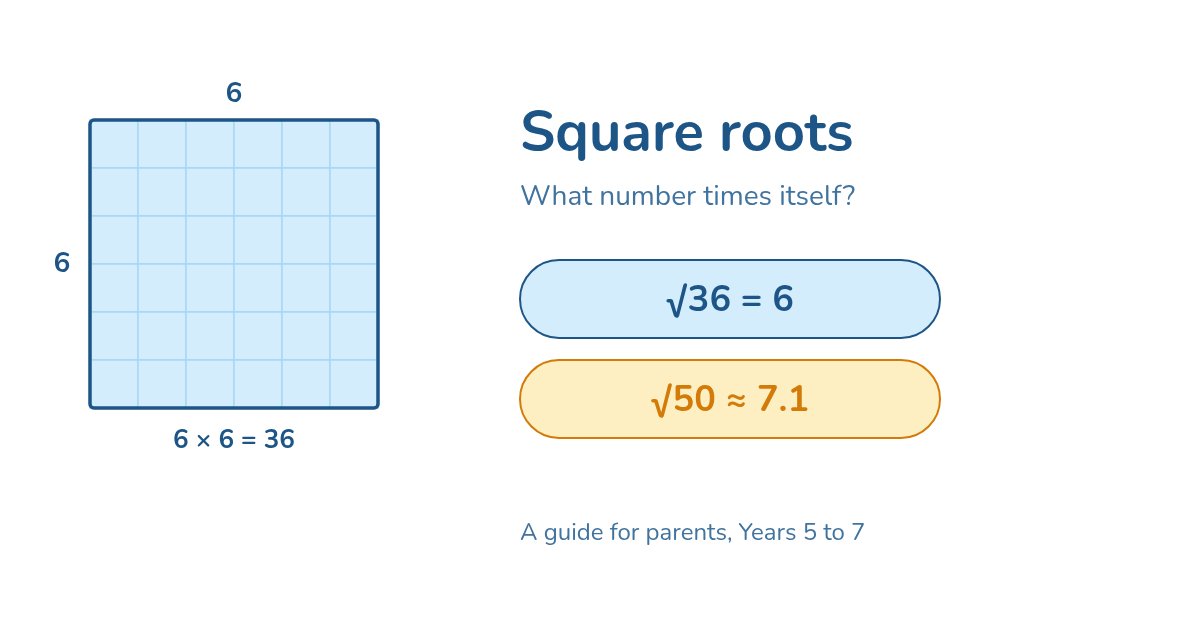
A square root answers a simple question: what number, multiplied by itself, makes this? For perfect squares the answer is neat (√36 = 6, because 6 × 6 = 36). For other numbers it sits between two whole numbers, which is where estimating comes in. Primary school usually stays with whole-number roots; secondary school opens the door to decimals and irrationals.
This guide covers what a square root is, how it links to square numbers, finding roots of perfect squares, using factor trees, estimating non-perfect roots, a light look at cube roots, where the idea sits in the Australian Curriculum, frequent slip-ups and home practice.
What a square root actually means
Start with a square you can build. Nine tiles in three rows of three make a square. The area is 9; the side length is 3. Saying "the square root of 9 is 3" is just naming that side length.
In symbols:
- 3² means 3 × 3 = 9 (three squared)
- √9 means "the number that squares to 9," which is 3
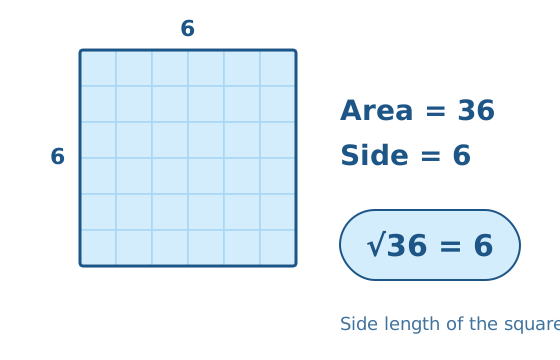
So squaring and taking a square root undo each other for positive numbers: √(3²) = 3, and (√9)² = 9. That "undo" idea matters later in algebra and in the order of operations, where roots sit with powers (the O in BODMAS / BIMDAS).
Primary classrooms almost always mean the principal (non-negative) square root. Strictly speaking, both 5 and −5 square to 25, but √25 is defined as 5. Negatives come later with integers and Year 7–8 number work; you don't need to open that door tonight unless the worksheet asks for both roots.
Perfect squares: the friendly cases
A perfect square is a whole number that is some whole number times itself. The first ones children meet are:
1² = 1, 2² = 4, 3² = 9, 4² = 16, 5² = 25, 6² = 36, 7² = 49, 8² = 64, 9² = 81, 10² = 100, 11² = 121, 12² = 144, 13² = 169, 14² = 196, 15² = 225
So √1 = 1, √4 = 2, √9 = 3, …, √225 = 15.
If your child can chant the square sequence, root questions on those numbers become recall: "what times itself is 144?" → 12. The square numbers guide owns arrays and the sequence; this page owns the reverse move and the √ symbol.
Handy bridge from times tables: many root facts are just familiar products. 8 × 8 = 64, so √64 = 8. Solid times tables make the first fifteen squares feel automatic.
Finding √n when it is a perfect square
Three home-friendly methods, in the order most classrooms use them.
1. Guess and check with nearby squares
Ask: is √50 closer to √49 or √64? Since 7² = 49 and 8² = 64, √50 is a bit more than 7. For a perfect square like √121, try 10² = 100 (too small) and 11² = 121 (exact), so √121 = 11.
2. Use prime factors (when the number is larger)
Write the number as primes, then pair equal factors. Example: 144.
- 144 = 2 × 2 × 2 × 2 × 3 × 3 = 2⁴ × 3² (see the prime factorisation guide for the tree and ladder)
- Pair the 2s and the 3s: (2 × 2) × (2 × 2) × (3 × 3) wait — cleaner in index form: √(2⁴ × 3²) = 2² × 3 = 4 × 3 = 12
Rule of thumb: every pair of identical prime factors becomes one factor outside the root. If every index is even, the number is a perfect square.
Check: 12 × 12 = 144. Yes.
Another: √3600. 3600 = 36 × 100 = (6 × 6) × (10 × 10), so √3600 = 6 × 10 = 60. Or via primes: 3600 = 2⁴ × 3² × 5², so √3600 = 2² × 3 × 5 = 4 × 3 × 5 = 60.
3. Recognise the square sequence
Keep a mental (or fridge) list of 1² through 15². Most primary worksheets stay inside that band. Beyond 15² = 225, factorisation or a calculator check is fair.
Estimating roots that aren't perfect
Worksheets love √2, √10, √50 and √90. None of these is a whole number.
Place them between neighbours:
- 7² = 49 and 8² = 64, so √50 is a little more than 7. A rough decimal: 7.1² = 50.41, so √50 ≈ 7.1
- 3² = 9 and 4² = 16, so √10 is a bit more than 3. 3.1² = 9.61, 3.2² = 10.24, so √10 ≈ 3.16
- √2 sits between 1 and 2. 1.4² = 1.96, 1.5² = 2.25, so √2 ≈ 1.41
Children don't need the word irrational in Year 5–6, but it helps parents to know: √2 never ends and never repeats as a decimal. Leaving the answer as √2 is often the exact form secondary school wants; a decimal is an approximation.
On a number line, √50 sits just right of 7; √10 sits a little past 3. Linking roots to position on a line mirrors what children already do with comparing numbers and the empty number line.
Simplifying roots (a Year 7 taste)
Sometimes √72 is left as 6√2 rather than a long decimal.
- 72 = 36 × 2, and 36 is a perfect square
- √72 = √(36 × 2) = √36 × √2 = 6√2
Same idea with factors: 72 = 2³ × 3², so √72 = √(2² × 3² × 2) = 2 × 3 × √2 = 6√2.
If your child's sheet only asks for a whole-number root or a rounded decimal, you can skip this section. It becomes standard in Year 7 when indices and roots sit together.
Cube roots, lightly
A cube root asks: what number times itself three times makes this? ∛8 = 2 because 2 × 2 × 2 = 8. ∛27 = 3; ∛64 = 4; ∛125 = 5.
Cube roots pair with cube numbers the same way square roots pair with square numbers. Primary work is usually recognition of the first few cubes; don't mix the symbols √ and ∛ on the same practice sheet until each is solid on its own.
Everyday moments that use square roots
- Garden tiles. "We have 64 pavers for a square patio — how many along each side?" → √64 = 8.
- Screens and photos. Diagonal sizes and aspect talk sometimes touch Pythagoras (a² + b² = c²), which needs square roots; keep that as a future Year 8–9 link unless the homework names it.
- Speed and distance word problems in later years occasionally undo a square; for now, stick to "side of a square" stories.
- Spreadsheets and calculators. The √ button is fine for checking; insist children explain "because 9 × 9 = 81" before they tap.
Worded questions still need the usual reading habits from the word problems guide.
Worked examples you can talk through
Example A — exact root. Find √169.
- 10² = 100 (too small), 13² = 169 (exact)
- Or factors: 169 = 13 × 13 = 13², so √169 = 13
- Check: 13 × 13 = 169
Example B — estimate then refine. Estimate √80.
- 8² = 64, 9² = 81, so √80 is just under 9
- Try 8.9² = 79.21; 8.95² ≈ 80.1
- Sensible estimate: about 8.9 (or "a touch under 9")
Example C — simplify. Write √48 in simplest radical form (Year 7 style).
- 48 = 16 × 3
- √48 = √16 × √3 = 4√3
- Check: 4√3 × 4√3 = 16 × 3 = 48
Example D — area story. A square vegetable bed has area 196 m². How long is each side?
- Side = √196
- 14 × 14 = 196, so each side is 14 m
Example E — "undo" a square. A number was squared and the result was 225. What was the number (primary answer)?
- √225 = 15, because 15 × 15 = 225
- (Later years may also mention −15; primary sheets usually want 15.)
Talk the checks out loud. The habit "square it back to check" catches most slips faster than any worksheet tip.
How square roots link to other skills
Roots are not a lonely topic. They sit on top of ideas your child may already have guides for.
- Square numbers and arrays. Side ↔ area language. See square numbers.
- Factors and primes. Pairing equal prime factors to pull roots out. See factors and multiples and prime factorisation.
- Powers in BODMAS. Roots and orders share the same "slot" before × and ÷. See order of operations.
- Cube numbers. Same family, three copies instead of two. See cube numbers.
- Algebra. Solving x² = 49 leads to x = 7 (and later x = ±7). See algebra.
- Place value and decimals. Estimating √50 ≈ 7.1 needs comfort with tenths. See decimals and rounding.
If one of those foundations is wobbly, repair it before drilling √ worksheets. A child who still confuses 3² with 3 × 2 will find every root question harder than it needs to be.
Where square roots sit in the Australian Curriculum
Square roots grow out of square numbers and factors, then deepen in lower secondary.
Years 5–6. Children work with factors, multiples, primes, composites and square numbers (Year 5 maths, Year 6 maths; AC Year 5, AC Year 6). "What number times itself?" appears as reverse square language before the √ symbol is fluent for every child.
Year 7. Students represent numbers using powers of primes and extend into square roots and related index ideas (AC Year 7). Estimating non-perfect roots and simplifying expressions like √72 = 6√2 become normal. There isn't a separate Ziado Year 7 overview page yet, so the AC Year 7 link is the curriculum anchor.
Schools choose their own order inside each year. Victorian schools on Curriculum 2.0 follow a closely related sequence. This page is not a NAPLAN drill sheet.
Slip-ups you are likely to see
-
Thinking √(a + b) = √a + √b. √9 + √16 = 3 + 4 = 7, but √(9 + 16) = √25 = 5. Roots do not split over addition. Fix: try a tiny counter-example every time the myth appears.
-
Halving instead of rooting. "Half of 36 is 18, so √36 = 18." No — √36 = 6. Fix: always ask "what times itself?"
-
Mixing square and cube. √8 is not 2 (that's ∛8). √8 ≈ 2.83 because 2.8² = 7.84. Fix: say the full phrase "square root" or "cube root" out loud.
-
Forgetting that √25 is 5, not ±5, on primary sheets. Both roots appear later; follow the worksheet's wording.
-
Leaving a composite inside a 'prime factor root'. √12 is not "done" as √(2 × 6); simplify to 2√3 when the class has reached that skill, or leave √12 if estimating.
-
Calculator-only answers with no sense-check. √49 = 7.000… is fine, but √50 ≈ 7.071 should be checked against 7² = 49.
-
Confusing 3² with 3 × 2. 3² = 9, not 6. The order of operations guide covers powers; roots undo them.
Calculator habits that still build sense
Calculators and phone apps spit out √2 = 1.414213562… in a blink. That is useful for checking, not for replacing understanding.
Agree a house rule for homework week:
- Predict the neighbours first. Before pressing √, say "between 8 and 9" for √70.
- Square the answer back. If the screen says 8.3666 for √70, multiply 8.3666 × 8.3666 and see it near 70.
- Know when exact form is better. Leaving √2 beats a long decimal if the sheet asks for exact value.
- Watch degree/radian modes on scientific calculators — not a primary issue, but Year 7+ kids sometimes hit trig buttons by mistake.
Mental maths still matters: estimating √50 ≈ 7 is faster than unlocking a phone in a test. The mental maths strategies guide has broader estimation habits; estimate before you add shows the same "sense-check first" idea for +/−.
Practising at home
Keep sessions short (five to ten minutes) and concrete first.
- Tile squares. Build 1×1, 2×2, 3×3 with blocks or paper squares. Say both "area 9, side 3" and "√9 = 3."
- Square flash to root flash. Call out 7 → child says 49; then call out 49 → child says 7.
- Between which two? Pick √40, √75, √200. Name the whole-number neighbours and which is closer.
- Factor-tree roots. Take 196: 196 = 2² × 7², so √196 = 2 × 7 = 14. Check 14 × 14.
- Kitchen estimate. "About how long is the side of a square cake tray if the area is 400 cm²?" → √400 = 20.
If homework turns tense, pacing ideas sit in the homework without tears guide. For a bigger-picture check on progress, open is my child behind in maths? or when to worry about maths.
When to look a little closer
Touch base with the teacher if your child:
- still confuses "times itself" with "times two" after several weeks of square work
- cannot list the first ten square numbers with support
- freezes every time the √ symbol appears, even on √9 or √16
- estimates √50 as 25 (halving) repeatedly
A single tough sheet is ordinary. Ongoing mix-ups between squares, roots and halves deserve a calm teacher chat. New symbols can spike nerves; the maths anxiety guide has practical settling ideas.
FAQ
What is a square root in simple words?
It is the number that, multiplied by itself, gives the number under the root sign. √49 = 7 because 7 × 7 = 49.
Is a square root the same as dividing by two?
No. Half of 36 is 18; the square root of 36 is 6. Always ask "what times itself?"
What year do Australian students learn square roots?
Square numbers and "what times itself?" language build in Years 5–6. The √ symbol, non-perfect roots and simplifying (like √72 = 6√2) are standard Year 7 work, with timing varying by school.
Why isn't √2 a nice decimal?
Because 2 is not a perfect square. √2 is irrational: its decimal never ends or repeats. Approximations like 1.41 are fine for estimating; exact answers often stay as √2.
What is the difference between ² and √?
The small raised 2 (²) means "multiply by itself" (square). The √ symbol means "undo that" (square root). So 5² = 25 and √25 = 5. They reverse each other for positive numbers.
Try this tonight
Pick three perfect squares your child knows (25, 64, 121). Ask for each root, then reverse: give the root and ask for the square. Finish with one estimate: "√70 is between which two whole numbers?" (8 and 9, because 8² = 64 and 9² = 81).
Want a quick read on how number ideas — including squares and roots — are travelling? Run Ziado's free check from a home device; most families finish in around ten minutes. The path adapts after every response, rising or easing so it matches your child instead of a set script. You see an early snapshot the moment the last question lands, still without creating a login or sharing card details, and signup opens the complete placement afterwards. √ symbols are not the focus of the check, NAPLAN is not the design brief, and no learning difficulty can be diagnosed from it. How week-to-week practice works is on the Ziado maths page, and both Individual and Family options open with fourteen days free — see pricing for what applies now.
Curious how number skills like squares and roots are going?
Ziado's free check is a one-off, roughly 10-minute adaptive diagnostic with partial results only - no account, no card. The full placement unlocks after signup.
Start the free maths check