Conjunctions explained for parents (Australia)
A mid-primary writer brings home a goal: "Use a greater variety of conjunctions." The checklist ticks and and but, then asks for because, when and although. At dinner your child says "I like soccer but I hate running," which is perfect — and then writes "I like soccer. But I hate running." as two chopped lines, and you're not sure whether the capital But is allowed.
Conjunctions are the joining words that glue ideas together: and, but, or, so, because, when, if, although and many more. Children speak them long before they can name them. School adds labels (coordinating, subordinating, correlative), comma habits, and the craft of choosing the join that shows the real relationship — time, cause, contrast or choice.
The live simple, compound and complex sentences guide owns whole sentence types and mentions conjunctions as the glue. This page owns the joining words themselves: what they are, the main groups with plenty of Australian examples, how they differ from prepositions, comma patterns, reading and writing uses, curriculum timing, mix-ups and home games.
What is a conjunction?
A conjunction joins words, phrases or clauses.
- Words: toast and Vegemite
- Phrases: before school or after sport
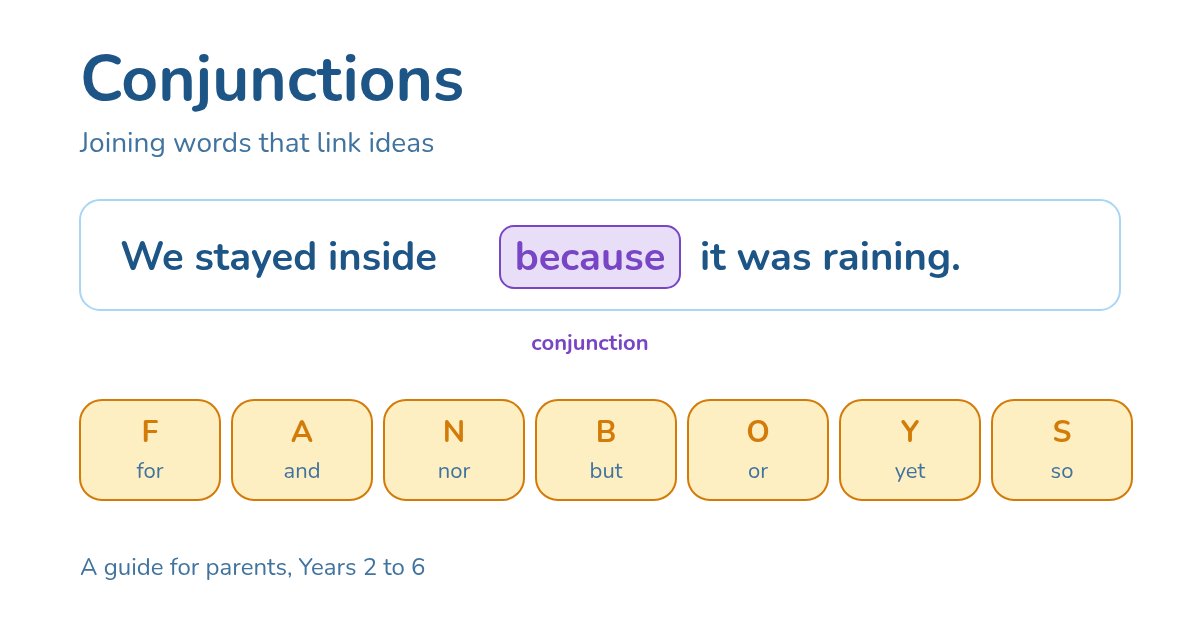
- Clauses: We stayed inside because it was storming.
Without the conjunction, you often get two short sentences or a unclear smash-up: "We stayed inside. It was storming." Both can be fine stylistically, but the conjunction because shows why. That meaning link is the real job.
Conjunctions are a word class, sitting beside nouns, verbs and adjectives, pronouns, adverbs and prepositions. Children don't need the label early; they need flexible joining in speech first, then in writing.
Coordinating conjunctions (FANBOYS)
Coordinating conjunctions join equals: two words, two phrases, or two independent clauses (each could be its own sentence).
Australian teachers often use FANBOYS:
- For (meaning because — rare in kids' writing)
- And (adds)
- Nor (adds a negative; uncommon early)
- But (contrasts)
- Or (offers a choice)
- Yet (contrasts, a bit like but)
- So (shows result)
Everyday examples:
- Mia packed her hat and her drink bottle.
- We can walk or we can ride.
- The magpie swooped, but nobody was hurt.
- It started raining, so the match was cancelled.
When a coordinating conjunction joins two independent clauses, a comma usually sits before it: The siren went, and everyone lined up. Short joins sometimes skip the comma in casual writing; many Year 3–4 teachers still prefer it before but and so. The punctuation guide covers comma habits more broadly.
Starting a sentence with And or But. Older style guides banned it; modern classroom advice is softer. Occasional sentence-starting But for emphasis is fine in storytelling. A whole paragraph of And then… And then… is what teachers usually want to tidy.
Subordinating conjunctions
Subordinating conjunctions attach a dependent (subordinate) clause to a main clause. The dependent clause cannot stand alone with full meaning.
Common ones children meet:
Time: when, while, as, before, after, until, since, once, whenever
Cause / reason: because, since, as
Condition: if, unless, provided that
Contrast / concession: although, though, even though, whereas, while
Place: where, wherever
Purpose / result (later): so that, in order that
Examples:
- When the bell rings, we pack up. (time)
- I wore boots because the oval was muddy. (reason)
- If it rains, training moves to the hall. (condition)
- Although she was tired, she finished the chapter. (contrast)
Notice the clause after although — she was tired — needs the main clause to make a full idea. That's the dependent clause.
Comma tip: when the subordinating clause comes first, use a comma: Before we eat, we wash our hands. When it comes second, you often skip the comma: We wash our hands before we eat.
Subordinating conjunctions are the engine of complex sentences in the sentence-types guide. Here the focus is choosing the right joiner for the meaning you want.
Correlative conjunctions
These come in pairs and share the load:
- both … and
- either … or
- neither … nor
- not only … but also
- whether … or
Examples:
- She plays both soccer and netball.
- Either* we leave now or* we miss the tram.
- He likes neither olives nor anchovies.
- Not only* did they win, but* they also broke the record.
Agreement tip parents notice: Neither the cats nor the dog is outside (verb often matches the closer noun in careful writing). Keep this light unless the homework targets it; [subject–verb] sense grows with verb tenses and sentence work.
Conjunction or preposition?
Some words wear two hats. Before, after, until, since, for, as can be conjunctions or prepositions, depending on what follows.
- Preposition (object is a noun/pronoun): We played before lunch. / Wait until Friday.
- Conjunction (joins a clause with a subject + verb): We played before the rain started. / Wait until Dad finishes the call.
Quick test: if a full mini-sentence follows (the rain started), you're in conjunction territory. If only a noun follows (lunch), it's likely a preposition.
For is tricky. As a coordinating conjunction it means because (Listen carefully, for the instructions are brief) — rare in primary writing. As a preposition it's everywhere (a gift for Nana).
How conjunctions help with reading
Joining words are comprehension signposts.
- Because / so → cause and result (see also cause and effect)
- But / although / however (and related) → contrast; expect a turn
- When / while / before / after → sequence and timing (see sequence)
- If / unless → conditions; useful in instructions and persuasive texts
When a child reads past although without noticing the twist, summaries go wrong. Practise pausing: "What changed after but?" That habit supports inference and main idea work without turning reading into a grammar quiz.
In persuasion, conjunctions frame claims: Although plastic bags are handy, they harm waterways, so we should reuse cloth bags. Spotting the concession (although) helps kids evaluate arguments.
How conjunctions help with writing
Strong writing isn't "more big words." It's clearer relationships.
- Upgrade the default and. We went to the beach and it was windy and we flew a kite → We flew a kite at the beach because the wind was strong, or It was windy at the beach, so we flew a kite.
- Show contrast on purpose. I wanted to keep reading, but my eyes were sore.
- Move a clause for emphasis. Because the ferry was late, we missed the show. puts the reason first.
- Avoid choppy stacks. Five full stops in a row can feel robotic; one thoughtful when or although often flows better.
- Don't force fancy joiners. Whereas and furthermore sound odd in a Year 2 recount. Match the joiner to the child's voice and year.
For dialogue, conjunctions appear inside speech ("I will if you will"); see dialogue. Morphology links (un- + happy) are separate — see prefixes and suffixes.
Worked rewrites you can try together
Choppy recount → clearer joins
Original: We arrived. The gate was shut. We waited. Mum rang the office.
Possible rewrite: When we arrived, the gate was shut, so we waited while Mum rang the office.
Talk about what each joiner does: when (time), so (result), while (same time).
Wrong relationship → fixed
Original: I finished my reader although I was proud. (contrast word, but the ideas aren't contrasting)
Better: I finished my reader, and I was proud. or I was proud because I finished my reader.
Fragment repair
Fragment: If we get there early.
Full: If we get there early, we can choose our seats.
Correlative polish
Weak: She likes drawing and also she likes coding.
Stronger: She likes both drawing and coding.
These micro-edits teach meaning, not just "add a fancy word."
Conjunctions beside other grammar tools
Parents sometimes lump every small word together. A quick map:
- Conjunctions join clauses/ideas (because, but, when).
- Prepositions sit before a noun (under the desk) — prepositions guide.
- Adverbs modify verbs/adjectives/other adverbs (quickly, very, outside as adverb) — adverbs guide.
- Pronouns stand in for nouns (she, them, who) — pronouns guide.
- Sentence types (simple / compound / complex) describe the whole structure — sentences guide.
If homework says "circle the conjunction," don't circle under in under the desk. If it says "add a subordinating conjunction," and won't do the job.
Conjunctions in the Australian Curriculum
Joining sentences is taught inside Language within the Australian Curriculum: English (version 9).
- Year 2 — compound sentences with coordinating conjunctions (AC Year 2; Year 2 reading)
- Year 3 — clauses; growing control of joining (AC Year 3; Year 3 reading)
- Year 4 — complex sentences with subordinating conjunctions for relationships such as time and cause (AC Year 4; Year 4 reading)
- Years 5–6 — using complex structures for effect; embedded clauses (AC Year 5, AC Year 6; Year 5 / Year 6 reading)
Schools sequence topics differently. This guide is not a NAPLAN primer; NAPLAN reading may include joining words inside comprehension, and writing rubrics reward clear cohesion.
Mix-ups you're likely to see
- Comma splice with no conjunction. The dog barked, the cat ran. Fix: add and/so, or use a full stop, or (later) a semicolon.
- Dependent clause left alone. Because we were late. Fix: attach a main clause — Because we were late, we sat near the door.
- And overload. Every idea chained with and. Fix: pick one relationship word (so, but, because) or split sentences.
- Wrong joiner for the meaning. I was tired so I kept playing when the child means although. Ask: "Is the second idea a result or a contrast?"
- Treating then as a conjunction. We ate then we walked needs and then or a full stop: We ate. Then we walked. (Then is usually an adverb.)
- Mixing preposition and conjunction uses of before/after/since (see above).
- Capital Because mid-sentence. Only capitalise after a full stop (unless it's a title).
Oral language first, labels second
Children who say flexible joins write them more easily later. Dinner-table prompts beat grammar posters:
- "Tell me that again using because."
- "Can you say the same idea with although?"
- "Give me two options with either…or."
If the spoken version is stuck on and then, writing will be too. Build the ear for contrast and cause before insisting on the words coordinating and subordinating. Labels help when the teacher uses them; meaning helps every day.
English as an additional language households can practise the same joins in the home language first, then map them onto English equivalents. The relationship (cause, time, contrast) travels even when the word list differs.
Games to play at home
- Conjunction cards. Write and, but, or, so, because, when, if, although on sticky notes. Draw one; both of you make a true sentence about today.
- Sentence surgery. Take a choppy recount (We went. We swam. We got cold.) and join with two different conjunctions; talk about how meaning shifts.
- Because hunt. While reading a picture book or newsbite, tap every because/so/but/when. Ask what relationship it shows.
- Either/or choices. At the shops: Either we get apples or we get bananas — you pick. Builds correlative pairs orally.
- Although challenge (Years 4+). Start with Although… and finish a full sentence without trailing off.
Keep it playful. When decoding or fluency is the real blocker, begin at how to help a struggling reader. Questions about progress have their own pages: is my child behind in reading? plus when to worry about reading.
When to look a bit closer
Check in with the teacher if, after plenty of modelling, your child:
- still only ever writes and to join ideas in Year 4+
- regularly leaves Because… fragments as whole answers
- misunderstands contrast words when reading (but, although) and retells the opposite idea
- avoids writing complex sentences entirely because "the commas are scary"
One messy draft is normal. A lasting inability to show cause or contrast may need targeted classroom support. Vocabulary breadth also helps joiner choice — see vocabulary while reading.
FAQ
What is a conjunction in simple words?
A joining word. It links words, phrases or whole ideas: and, but, or, so, because, when, if, although and others.
What is the difference between coordinating and subordinating conjunctions?
Coordinating (FANBOYS) joins equals — two ideas that could each be a sentence. Subordinating joins a main idea to a helper idea that can't stand alone (because it rained).
Is because a coordinating conjunction?
No. Because is subordinating. For can be coordinating when it means because, but children rarely need that use.
Can I start a sentence with Because or But?
Yes, when a full sentence follows (Because we left early, we found a park. / But nobody had brought the ball.). Avoid leaving Because we left early. as a fragment.
How many conjunctions should a Year 4 paragraph use?
There's no magic count. One clear because or although beats five empty ands. Teachers look for the right relationship, not a checklist tally.
Try this tonight
Ask your child to tell you three things about their day. Write them as short sentences, then join two of them twice — once with and, once with because or but — and talk about which join tells the story better.
If you want a wider picture of reading — beyond joining words — Ziado's free check is built for that. Families usually wrap up in roughly ten minutes on a laptop or tablet at home; each reply steers the next item so the route fits the child, not a fixed ladder. As soon as they stop, a first preview of results appears — still no login or card — and signup is what opens the complete placement afterwards. It will not quiz the word conjunction, NAPLAN is outside its brief, and a language or reading difficulty cannot be diagnosed from the score. The Ziado reading page explains steady practice; choose Individual or Family and you still get fourteen days free up front — pricing has the live details.
Wondering how your child's sentence joining is tracking?
Ziado's free check is a one-off, roughly 10-minute adaptive diagnostic with partial results only - no account, no card. The full placement unlocks after signup.
Start the free reading check